Pages

Wednesday, 17 July 2013

87. Slavonian Grebe (Podiceps auritus)

The Slavonian Grebe is a small grebe which breeds on shallow lakes and ponds with vegetation in parts of northern Europe, and winters mostly around the coast of Europe, although generally not southernmost Europe. This photo shows the breeding plumage and in winter, it is much plainer, retaining the pale bill tip, and having a black cap extending down the back of the neck contrasting sharply with white cheeks, a black back and white breast with a light grey collar.

Slavonian Grebe, ©Steve Garvie, via Wikimedia Commons.
Slavonian Grebe sketch.

First page in my new sketchbook, it's a lot nicer than my old one :o) I only bought a cheap one to begin with as I didn't know if I'd be able to keep this up, so thought it would be worth paying a bit more for better paper as I am still successfully trundling on now.

86. White-billed Diver (Gavia Adamsii)

White-billed Diver is the behemoth of the divers, and also the most scarce. It resembles a Great Northern Diver, but larger and with a yellowy white bill. In non-breeding plumage, it differs from Great Northern Diver in being tinged browinish, having slightly more pronounced barring on its back, an often more extensive dark half-collar, and partly retaining the yellowish bill colour - it may also point its bill upward slightly. This photo is of a juvenile - it was difficult to find good photos of an adult - which is paler and has a much more scaly pattern on its back than the adult. White-billed Divers breed in parts of north Siberia, Alaska and Canada, and winter around the north coast of Fennoscandia and along the south coast of Alaska extending down the Canadian coast.

Yellow-billed Diver, ©poecile05, via Flickr Creative Commons.

White-billed Diver sketch.
Bit rushed towards the end but I just about managed to finish it. Also, I have now filled a whole sketchbook with drawings - this was the last page! Tomorrow I start my new sketchbook, how exciting.

Monday, 15 July 2013

85. Great Northern Diver (Gavia immer)

Larger and more heavily-built (look at that humongous bill) than the Black-throated Diver, Great Northern Divers breed in Iceland and parts of Greenland, North America and Canada, wintering around the northwest coasts of Europe and further south around North America. Also like the other divers, in winter their plumage is much plainer, being dark and plain above and white underneath. A distinctive partial dark half-collar usually stays on the winter plumage.

Great Northern Diver, ©omarrun, via Flickr Creative Commons.
Great Northern Diver sketch.

Back on the time limit today so I didn't quite finish, fairly pleased with my efforts though.

Great Northern Divers make one of my favourite bird sounds ever - heard in this ace clip from about 1:05 onwards....they dance too!


Sunday, 14 July 2013

84. Black-throated Diver (Gavia Arctica)

The Black-throated Diver has a similar distribution to the Red-throated Diver (although it's not generally found in Iceland!), however in North America/Canada and eastern Siberia the very similar Pacific Loon (Gavia pacifica) occurs instead. The Black-throated Diver's preferred breeding habitat is clear lakes or calm sea bays. In summer plumage, it's easily told apart from Red-throated Diver, but in winter when they look quite similar, the Black-throated Diver has less extensive white on its throat, a 'full-chested' appearance, more or less uniform black on its back and often a peaked forehead (as in the photo below). I have never seen a Black-throated Diver in summer plumage - maybe that should be next on my list.

Black-throated Diver, ©Stefan Berndtsson, via Flickr Creative Commons.
Black-throated Diver drawing.
Wahey, colour again! It didn't take so long today as the pose is more straightforward. I am really enjoying drawing the divers, maybe you can tell!

Saturday, 13 July 2013

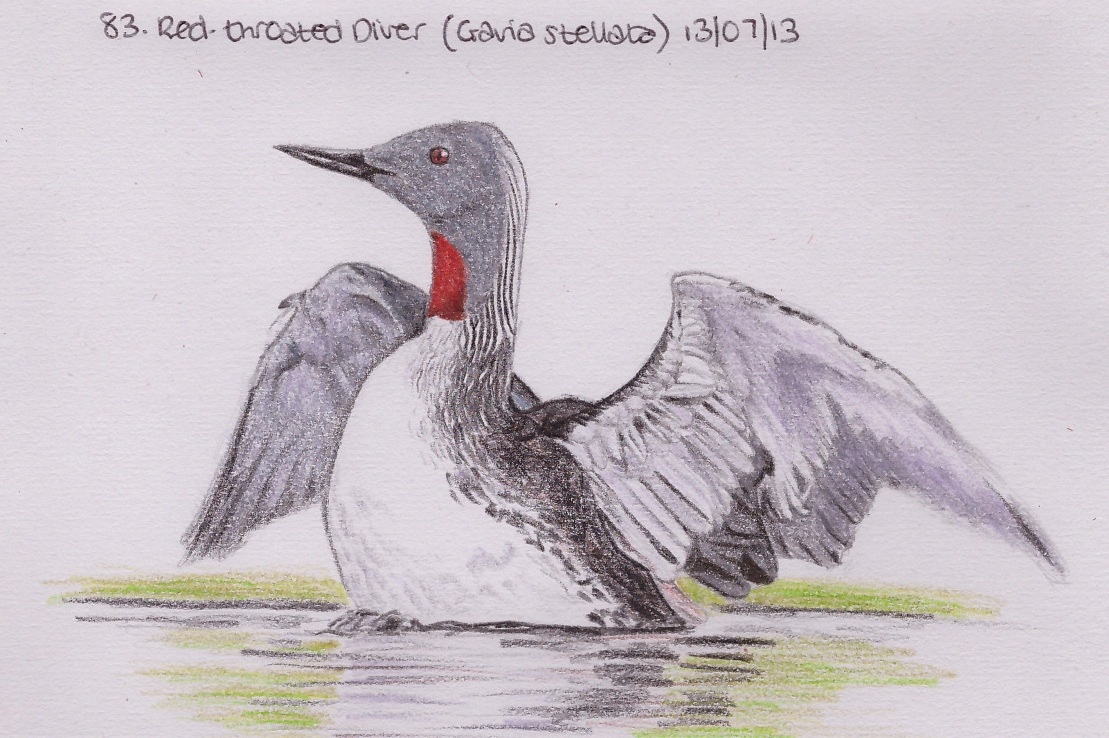
83. Red-throated Diver (Gavia stellata)

I've been looking forward to this one - I love the divers, and Red-throated is probably my favourite of them all! It is the smallest of the divers (although not much smaller than Black-throated) and breeds in northern Scotland, Iceland and Scandinavia (as well as across Siberia and parts of Canada and North America) on tundra or boggy areas. In winter it is found offshore further south of its breeding grounds. This photo is of the superb summer plumage, but in winter it is a lot plainer, having a white throat and belly, and dark grey above with white speckling. It can be told apart in this plumage from the similar-looking Black-throated Diver by its slightly narrower bill (often held tilted upwards), white extending quite far back around the throat and in front of the eye, and a 'flat-chested' appearance.

Red-throated Diver, ©Steve Garvie, via Wikimedia Commons.
Red-throated Diver drawing.

I spent much longer than my usual 45 minutes on this - it's one of my favourites and I'd had a productive day of studying so I felt I could spare the time! I am pretty happy with it - the shade of red was quite difficult and I don't think I quite got it, but you should have seen my previous attempts.

Until last year I'd only seen Red-throated Divers in winter plumage, and always as pretty distant specks on the sea. So when I visited Iceland last September, getting a good view of one in its handsome summer plumage was near the top of my list! I was not disappointed - the below photo was taken on my wee Canon digital compact which has a pretty negligible zoom - through binoculars I could count the stripes on the back of the diver's head - so I was more than happy with this close Red-throated Diver encounter. Hooray!

It is a Red-throated Diver, honest. Snæfellsnes peninsula, Iceland 07/09/2012.

Friday, 12 July 2013

82. Helmeted Guineafowl (Numida meleagris)

The Helmeted Guineafowl is a bulky, chicken-like bird native to parts of Africa. It was once found in Morocco but is most likely extinct there now; it has also been introduced to southern France. Its preferred habitat is dry savannah-type or farmed countryside with scattered scrub and trees.

Helmeted Guineafowl, ©Lip Kee, via Flickr Creative Commons.
Helmeted Guineafowl sketch.

I know, major cop-out - I didn't even attempt the spots. That's a lot of spots though and once you start you've made a big commitment, a commitment for which I didn't have time tonight! I will make up for it with tomorrow's drawing! I am quite pleased with the the overall shape (although the feet are a bit on the big side), better than many of my efforts, and the angle of the head - I think (hope!) you can tell it's looking away slightly.

Thursday, 11 July 2013

81. Lady Amherst's Pheasant (Chrysolophus amherstiae)

Lady Amherst's Pheasant is closely related to the Golden Pheasant and was also introduced to the UK from China, in the 1900s. There is possibly a very small population here still, in the Bedfordshire area, but it has been in decline for a long time and it's uncertain as to whether any are left now. Its preferred habitat is woods with dense thickets, making it another tricky one to spot. The epic tail can be over a metre long, incredible! Like the Golden Pheasant, the male Lady Amherst's Pheasant can fan out the feathers on its nape when displaying.

Lady Amherst's Pheasant, ©Makuahine Pa'i Ki'i, via Flickr Creative Commons.
Lady Amherst's Pheasant sketch.


I'd rather not use a photo of a bird in captivity, but I did want to have a crack at drawing the entire bird rather than just a portrait today. Didn't quite have enough time/space for the whole tail but you get the general idea.