Pages

Showing posts with label Identiplant. Show all posts

Thursday, 9 June 2016

30 Days Wild | Day 8 - The Pea family

Today for 30 Days Wild I had a go at another of my Identiplant assignments, about Fabaceae - the Pea family. I'm fairly familiar with this family as many of its members grow near my office so I thought I should be able to get through it fairly quickly. For the first part of the assignment I had to find three of the four species Medicago lupulina (Black Medick), Trifolium dubium (Lesser Trefoil), Lathyrus pratensis (Meadow Vetchling) and Lotus corniculatus (Bird's-foot Trefoil), and describe their diagnostic features. I think these can all be found near my workplace but I haven't spotted any Meadow Vetchling this year, I don't think it is in flower yet - so I found the other three. For the second part of the assignment I had to find either Vicia sepium (Bush Vetch) or Vicia cracca (Tufted Vetch) and key it out using the Wild Flower Key; I found Vicia cracca.

Diagnostic features of the pea family (generally):
  • Usually compound pinnate or trifoliate leaves.
  • Unique flower structure: 5 sepals fused into tube, 5 free petals – upper standard, 2 wings on either side enclosing keel formed from 2 lower inner petals. 10 stamens within keel – lower 2/3 of all or sometimes all but one fused into tube surrounding carpel. 
Diagnostic features of Medicago lupulina:

  • Leaves have mucronate tips and are downy.
  • Flowers/fruit-heads stay upright once flowering has finished.
Black Medick (Medicago lupulina).
Diagnostic features of Trifolium dubium:
  • Leaves have no mucronate tips are are mostly hairless.
  • Flowers/fruit-heads droop down once flowering has finished.
Lesser Trefoil (Trifolium dubium).
As the previous two species are so similar, the diagnostic features are those which are crucial in telling the two apart. The difference between the flowers/fruit heads wasn't one that was particularly highlighted in the Wild Flower Key but it's one that I noticed in real life - we'll see what my tutor thinks of it. There are other diagnostic characteristics too, to do with fruit structure, but for these assignments I am only supposed to highlight features that I have actually observed - and I didn't find any ripe fruits yet!

Diagnostic features of Lotus corniculatus:
  • Yellow flowers with orange/red tinge – red buds.
  • Trifoliate leaves but with extra leaf pair at base of stalk.
  • Hairless oval leaves.
  • Solid stems.
  • Sepal points are erect, not reflexed as in L. pedunculatus (another very similar species).
Bird's-foot Trefoil (Lotus corniculatus).
I managed to successfully key out Vicia cracca using the Wild Flower Key. I won't post the whole sequence here, here's a pic of the start of the pea family key though - I am getting better at using these having never really got to grips with keys before this course, you can see why it's so important to be familiar with the terminology!

Start of the pea key!
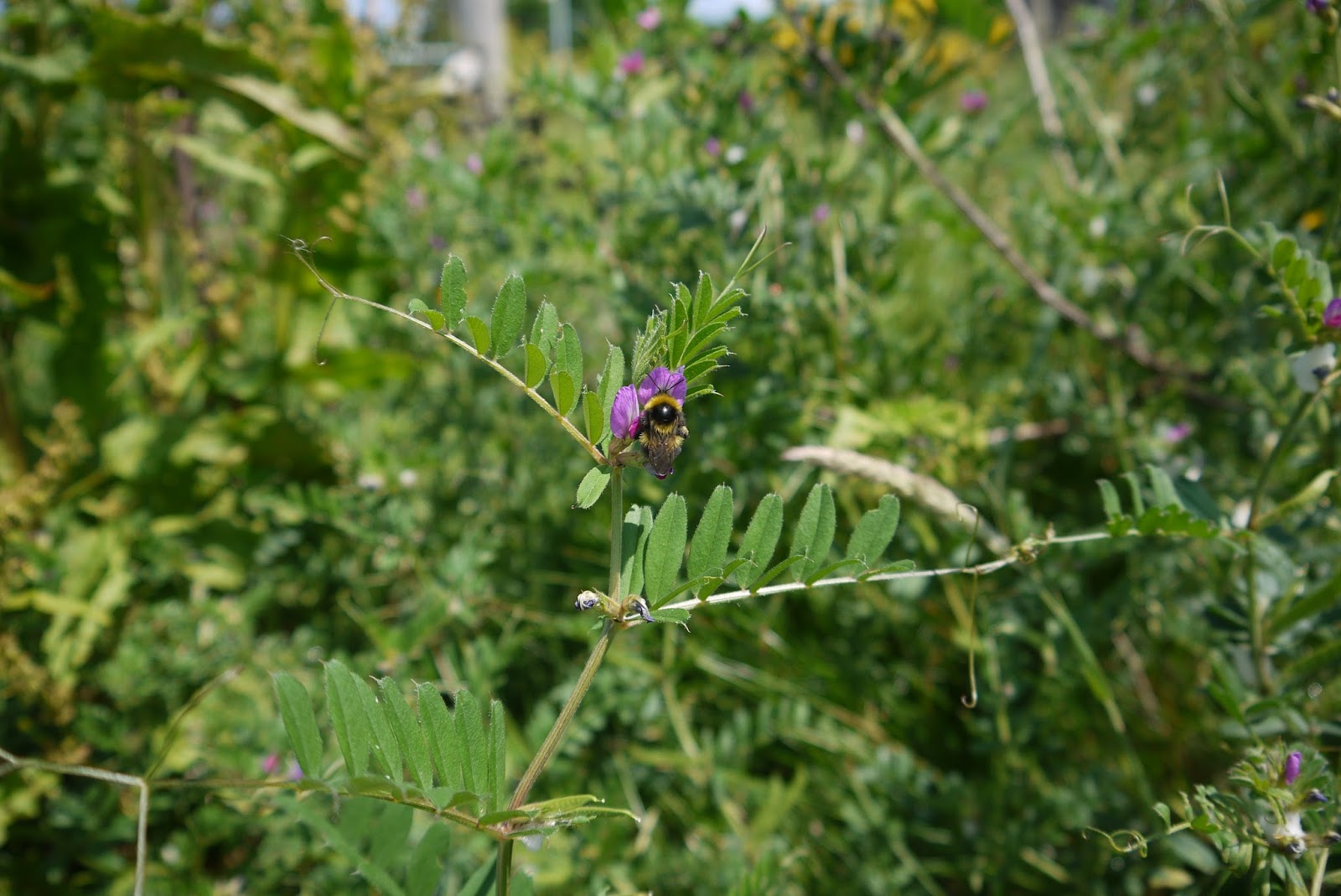
Tufted Vetch (Vicia cracca).
Then just for fun I also found two more pea family members!

Grass Vetchling (Lathyrus nissolia).
Hop Trefoil (Trifolium campestre).

Monday, 6 June 2016

30 Days Wild | Day 6 - Identiplant scavenger hunt 4

Today for 30 Days Wild I was once again on a lunch break quest to find plants with certain characteristics for one of my Identiplant assignments. I went to the railway embankment again and found a plant with tendrils (Hairy Tare - Vicia hirsuta), one with leaves that have a mucronate tip (Black Medick - Medicago lupulina), and one with leaves that have a cuneate base (Russian Comfrey - Symphytum x uplandicum). Tendrils are pretty self-explanatory; a mucronate tip is a little point or bristle on the end of an otherwise round or blunt-ended leaf; and a cuneate leaf base is pointed or wedge shaped.

Hairy Tare (Vicia hirsuta).

Russian Comfrey (Symphytum x uplandicum).

Black Medick (Medicago lupulina).
Hairy Tare (Vicia hirsuta) showing its tendrils.
Russian Comfrey (Symphytum x uplandicum) and
Black Medick (Medicago lupulina). View full size and you should be able to see the tiny mucronate tips of the Black Medick leaves.

Friday, 3 June 2016

30 Days Wild | Day 3 - Identiplant scavenger hunt 3

For day 3 of 30 Days Wild, I continued with my search for plants showing certain characteristics for my Identiplant assignment. This was one of the earlier assignments but this section of it is meant to be completed during or after June, as a revision exercise to help consolidate our learning of plant terminology. I am finding it really useful as I'd forgotten half of the terms since first studying the terminology unit!

Today I went out on my lunch break to an excellent grassy scrubby bank next to the railway near my office, looking for two more leaf characteristics, pinnate and pinnatifid. They make a similar pair as yesterday's palmate and palmately lobed leaves did. Pinnate means a compound leaf that is subdivided into leaflets, as a palmate leaf is, but instead of the leaves all spreading out from one point at the top of the stalk, they are arranged along the stalk on either side of it. A pinnatifid leaf has its veins arranged in the same way, spreading out from a central line instead of a central point as in a palmately lobed leaf, but instead of being subdivided into leaflets it is only deeply cut into pinnately-arranged lobes.

Pinnate leaves on Common Vetch (Vicia sativa).
Pinnatifid leaves on Pedunculate Oak (Quercus robur).
Comparing pinnate and pinnatifid leaves (the vetch is face-down as it wouldn't stay flat the right way up!).

Thursday, 2 June 2016

30 Days Wild | Day 2 - Identiplant scavenger hunt 2

Day 2 of 30 Days Wild, and my search for plants showing particular characteristics for my Identiplant assignment continues. Once again I went down to the canal towpath on my lunch break, and this time found a plant with palmately lobed leaves, and another with palmate leaves. Palmate in this context means multiple leaves or leaf veins spreading out from the top of the stalk. I couldn't get a Lupin leaf as it was growing behind a fence but hopefully you can see in the photo how the leaves spread out from a central point! The Mallow leaf has palmate veins, and its edges are lobed (and also toothed as it happens, but that wasn't a characteristic I was looking for on this occasion!).

Common Mallow (Malva sylvestris).

Garden Lupin (Lupin polyphyllus agg).

Common Mallow (Malva sylvestris) leaf - palmately lobed.

Wednesday, 1 June 2016

30 Days Wild | Day 1 - Identiplant scavenger hunt 1

It's day 1 of 30 Days Wild! Once again throughout the month of June, lots of people will be carrying out a daily 'random act of wildness' to bring them closer to nature. I and many others did this last June and I enjoyed it a lot, so I've signed up again this year! This June is probably going to be my busiest month this year however, as we will be moving house and I'm starting a new job; I'm also going on holiday for a week (this was planned before I knew about the new job and consequent move!). So while I'm going to try my best to keep up with 30 Days Wild, I may fall behind!

A lot of my random acts of wildness are going to involve plant identification - I'm currently studying the Identiplant course, so bits of my assignments will be perfect for 30 Days Wild. Today I'm starting the second part of Unit 2's assignment, which is about terminology. There is a lot of terminology to learn when it comes to describing plants! This part of the assignment is quite fun - it's a bit like a scavenger hunt, where you have to find plants with features that match particular terms:

Here's part of the assignment!
So on my lunch break today I headed down to the good old canal towpath (which I am going to miss when I leave this job) and found two plants - one with ovate (egg-shaped) leaves, and one with lanceolate (spear-shaped - e.g. like a blade of grass) leaves. You can see my answers written in the worksheet above, and here are the two plants!

Red Campion (Silene dioica).

Oregano (Origanum vulgare).
Lanceolate Silene dioica leaf and ovate Origanum vulgare leaf.

Wednesday, 27 April 2016

Kings Norton Nature Reserve 23/04/16

On Saturday I was back at my local patch for a very pleasant wander in the spring sunshine. This time my partner Chris came with me for a bit - he is not so into birds as me, but wanted to see what this place is that I keep going to every week! As a result I heard but did not see a few species, as Chris isn't too keen on stopping and loitering for ten minutes to try and catch a glimpse of an elusive bird :oD I saw/heard 36 species in all, of which one was new for me at this site, taking my patch total to 63. Here are my highlights:
  • Today's new species was, as anticipated, Blackcap - hooray. I didn't see them but I heard a couple in different parts of the reserve.
  • Chiffchaffs all over the place now - I lost count of how many I heard. Must try and do a proper count next time!
  • A very fleeting glimpse of a Reed Bunting flying away from me in the area behind Wychall Reservoir.
  • Willow Warbler singing near Merecroft Pool.
  • I heard Green Woodpecker yaffling somewhere in the area behind Wychall Reservoir.
  • Treecreeper - again, heard but not seen in a few parts of the reserve.
  • Quite a few Orange Tip and Small Tortoiseshell butterflies about. 
I bumped into fellow KNNR patch birder Adrian too, who had heard a Whitethroat singing briefly in the area behind Wychall Reservoir. Unfortunately it had stopped by the time I got there but maybe I'll find it next time. I was also on the lookout for some plants for my Identiplant assignment about the Ranunculus family, and this combined with the nice weather meant I ended up taking LOADS of photos!

British Waterways Meadow (HDR).
Bluebells by Merecroft Pool. So beautiful, I'm hoping to get some better photos before the flowers are gone.
Bluebells by Merecroft Pool.
Wood Anemone (Anemone nemorosa). Needed this one for my assignment!
Wood Anemone (Anemone nemorosa).
Something's killed a Magpie. My guess would be a Fox, or possibly could a female Sparrowhawk take on a Magpie?
Close-up of Magpie feathers.
Around the back of Wychall Reservoir.
Small Tortoiseshell butterfly (Aglais urticae).
Butterbur (Petasites hybridus).
Marsh Marigold (Caltha palustris), another one I needed for my assignment!
Marsh Marigold (Caltha palustris) (HDR).
I'm excited to say that the Friends of Kings Norton Nature Reserve have asked me to lead their Dawn Chorus Walk on the 7th of May, starting at 05:30am at Burmans Drive (opposite Wychall Park Grove), should be good!

FULL BIRD LIST


Blackbird Goldcrest Magpie
Blackcap Goldfinch Mallard
Blue Tit Great Spotted Woodpecker Moorhen
Bullfinch Great Tit Mute Swan
Buzzard Green Woodpecker Reed Bunting
Canada Goose Greenfinch Robin
Carrion Crow Grey Heron Song Thrush
Chaffinch Herring Gull Treecreeper
Chiffchaff House Sparrow Tufted Duck
Coot Jackdaw Willow Warbler
Dunnock Lesser Black-backed Gull Woodpigeon
Feral Pigeon Long-tailed Tit Wren

Tuesday, 23 February 2016

Kings Norton Nature Reserve 21/02/16

On Sunday I was very happy to be back at my local patch for the first time in a few weeks - the previous weekend I'd been both ill and not in Birmingham, and the weekend before that the weather had been truly dreadful! I still wasn't feeling 100% recovered from my illness (which I'd decided with the help of Dr Google was probably a chest infection), but I was determined to see what I could find at Kings Norton Nature Reserve. It was a good trip, assuming that none of my sightings were illness-induced hallucinations! I took plenty of (admittedly dreadful) photos of the best one, to be extra sure ;o)

Here are my highlights; I saw 38 species in all, of which one was a new one for me at this site. I've now seen 56 species in total at the reserve. It was a bit of a wildfowl extravaganza this time around....
  • 11 Teal on Wychall Reservoir - as far as I could tell. The marshy nooks and crannies of the reservoir make it a bit difficult to count the Teal, but obviously provide them with some nice habitat!
  • Four Goosanders and seven Tufted Ducks on Merecroft Pool.
  • Also on Merecroft Pool, TWO male Shovelers - I'd only previously had one there.
  • My most unexpected and exciting bird of this trip - a lovely male MANDARIN DUCK on Merecroft Pool! Provenance unknown but it sounds like he'd been doing the rounds of various local sites - I bumped into another birder who said a Mandarin had been seen at Upton Warren in the week, and Adrian (a fellow KNNR patch birder!) spotted a Mandarin in Cannon Hill Park on Monday morning. Most likely all the same bird. We may not ever see the Mandarin at KNNR again but I don't know, there are some very nice overhanging branches and secluded spots around the edge of the pool of the type favoured by Mandarins, I think he should come back ;o)
  • A pair of Grey Herons building a nest in an Alder on the island in Merecroft Pool.
  • A very large flock of Goldfinches in the bushes around the top end of British Waterways Meadow, with a few Siskins interspersed among them. I watched and listened for ages but couldn't find any Redpolls in there.
  • A Sparrowhawk flying over the Paddocks.
  • A Buzzard over Wychall Reservoir.
  • A Treecreeper in trees along the Rea Valley route, not long after I'd entered from Westhill Road.
Sadly I neglected the West Extension once again - I'd pretty much run out of energy by the time I reached Popes Lane, but am looking forward to getting back to KNNR for the guided walk this Saturday, by which time I am sure I'll be 100% recovered.

Here are a couple of scenes of the reserve from my trip:

Path down the side of the paddocks.
Pinehurst Meadow (HDR) - it was a bit windy for HDRs really, some dodgy alignment in there.

Unfortunately I hadn't brought my zoom lens with me, so could only take some truly dreadful record shots of the Mandarin!

View full size to spot the Mandarin!
I also took a few photos of the Herons building their nest, again rather far away:

Grey Herons nesting.

The reason I'd left my zoom lens behind was to bring my close-up lens instead, to photograph some plants - I've recently started a new course, Identiplant, which will enable me to develop my botanical identification skills to a more advanced level. At the moment I know quite a few common plants, but this course should equip me with the skills to use a floristic key properly and therefore the ability (in theory) to identify any plant! As part of my first assignment I had to find three monocots in flower; not too hard at this time of year, especially with the warm weather we've been having over much of winter. I don't actually have to take photos of the plants I find for my assignments, but I enjoy doing it and it's a good way to keep records. Here's what I found, hopefully my identifications are correct:

Galanthus nivalis (Snowdrop).
Crocus vernus (Spring Crocus).
Muscari armeniacum (Garden Grape Hyacinth). OK so I cheated a bit, I actually took this photo in our neighbour's front garden when I got home!

FULL BIRD LIST


Blackbird Goosander Nuthatch
Black-headed Gull Great Spotted Woodpecker Robin
Blue Tit Great Tit Shoveler
Bullfinch Greenfinch Siskin
Buzzard Grey Heron Sparrowhawk
Carrion Crow Herring Gull Starling
Chaffinch Jackdaw Stock Dove
Coal Tit Lesser Black-backed Gull Teal
Coot Long-tailed Tit Treecreeper
Dunnock Magpie Tufted Duck
Feral Pigeon Mallard Woodpigeon
Goldcrest Mandarin Duck Wren
Goldfinch Moorhen