Pages

Showing posts with label Malvern Hills. Show all posts

Wednesday, 4 November 2015

Magical Malvern Hills!

Having free time after completing my degree is marvellous :o) I went birding TWICE at the weekend, good times! After visiting my local patch on Saturday, on Sunday Chris and I went down to the Malvern Hills; I was hoping to maybe see the Ring Ouzels and Snow Buntings that had recently been reported there. 

The weather was very foggy throughout most of the journey there but luckily cleared as we approached Great Malvern. We headed straight up Happy Valley; although this is not the most interesting route up the hills and is also rather steep in places, it's where Ring Ouzels are frequently spotted around this time of year. It's thickly wooded at the bottom but starts to open out as you ascend, and it's around this zone where there are quite a few Rowan trees - hence the attraction for migrating thrushes.

Near the bottom of Happy Valley (HDR).
Heading up Happy Valley (HDR).

Delicious Rowan berries.....if you are a bird! (HDR)
We stopped to inspect a likely-looking Rowan tree not far from the path, which was the same one I found a flock of Brambling in two autumns ago. It's clearly a favoured spot as it was immediately obvious that it was jammed with Redwings stuffing their faces, along with a couple of Fieldfare. A few minutes of further scrutinity revealed a male Ring Ouzel, hurrah! We watched for a while and saw him fly around, being joined by another individual and landing in a few different spots before returning to the Rowan. NICE. We continued to the top of the valley where we stopped for lunch, and saw three Ring Ouzels fly past. It was so warm at our lunch spot that I heard a few grasshoppers rasping in the grass behind us.

It wasn't until we reached the ridge of the Hills and the view to the west opened up that we realised the entire surrounding landscape in all directions was covered in fog. The Malverns were like an island in the middle of a sea of cloud; it was impossible to tell how far away the ground actually was! Hopefully these photos will give some idea of how it looked although they don't really do it justice:

Chris, bemused by the abundance of fog.

Foothills on the western side rising through the fog.

Foothills on the western side rising through the fog.

Foothills on the western side rising through the fog.

Great Malvern being engulfed around its outskirts by the fog.
In search of Snow Buntings, we walked over the top of North Hill and circumnavigated it, but by that point I think there was too much disturbance and we saw no buntings. We did however see a Red Admiral flying over the summit - further evidence of how warm it was - and a pair of Stonechats on the eastern slope. 

On North Hill (HDR).
What with the Ring Ouzels (my first seen in the Malverns) and the mad weather we had had an excellent trip! I attempted a final two HDRs while we were waiting for the train back - Great Malvern station is one of my favourites :o)
 
Great Malvern railway station.


Great Malvern railway station.

Sunday, 20 April 2014

Easter Malvern magic!

It's the Easter holidays, wahey! For me that means a full 6 days off work as Birmingham University closes til the Thursday after Easter, good times. It's a good chance to get loads of studying done but also when the weather is good (which seems to have finished now) to get out and about, so on Friday Chris and I headed to one of our favourite destinations, the Malvern Hills. After my previous visit to the southern end of the hills, we decided to return there to explore a bit more of the area. It was a brilliant day! As I've previously mentioned, one of the great things about the Malverns is the range of habitats you can see in a very compact area. Here are some of the different landscapes we experienced on our walk!

Looking north up the Malvern range, the tallest one in the distance is the Worcestershire Beacon.
The terraced hillsides of the Herefordshire Beacon/British Camp.

Blue water at Gullet Quarry.
Awesome geology at Gullet Quarry! Unfortunately it's too dangerous to get close up to the rocks for a proper look :o(
View from Castlemorton Common.
Castlemorton Common (with a Buzzard).
Castlemorton Common. I heard a distant Grasshopper Warbler in this area but did not see it!
The obligatory cute lambs photo.
Walking back up towards the British Camp Reservoir.
Highlights of the day included seeing my first Redstarts and Whitethroats of the year, a super-cool Peregrine and friendly Raven both perching and flying around Gullet Quarry, and a rustling among dead leaves on a bank to one side of the path which revealed itself to be a Bank Vole. We also saw 6 butterfly species (Comma, Orange Tip, Green-veined White, Peacock, Small Tortoiseshell and Speckled Wood).

Raven (and Jackdaw!) at Gullet Quarry.

Small Tortoiseshell (Aglais urticae) butterfly on Nettles (Urtica dioica).
I was as usual on the lookout for plants to attempt to ID as well:

I'm not too sure, but I think this might be Hairy Sedge (Carex hirta). Edit: no it's Field Wood-rush (Luzula campestris)! Laughing and learning....(mainly learning).
Here is some very small and cute Germander Speedwell (Veronica chamaedrys)!
Hmmm this is most probably Common Dog-violet (Viola riviniana) but I should've had a closer look at it to check it isn't Early Dog-violet (V. reichenbachiana).
Erm. At first I thought this was Bugle (Ajuga reptans) but the more I look at it the more I think it might be Ground Ivy (Glechoma hederacea). If anyone is more certain do let me know!
Greater Stitchwort (Stellaria holostea).
We finished off our day by stuffing our faces with delicious food in The Nag's Head in Great Malvern, before heading home to watch The Muppets film. What a superb day!

Sunday, 27 October 2013

Autumn fun in the Malvern Hills

Yesterday, as part of my continued making the most of my short study break before my next Open University module starts, I decided to go to the Malvern Hills. They're always a favourite destination for me anyway - they're very easy to get to, have a good range of habitats and feel like proper hills that you can have a good walk on, whilst still being very manageable - it's impossible to get lost there, and there are plenty of places in Great Malvern to refuel with tasty grub (very important for my shrew-like metabolic rate). My decision was also influenced by Worcestershire Birding's tweet from Thursday, maybe this time I would finally get lucky and see a flipping Ring Ouzel!

I started by walking very slowly up Happy Valley, as this was one of the places Ring Ouzel had been reported. Plus it had also started raining so I was in no hurry to get to the top! Treecreeper and Green Woodpecker were nice sightings as I made my way up through the trees. Unfortunately it seemed as though the Ring Ouzel had probably moved on since Thursday....however I was soon distracted from Ouzel-related thoughts towards the top of the valley, by a Rowan tree a short distance from the path which turned out to be stuffed with Brambling, and topped off with a single Fieldfare! I was dead excited as in my limited experiences, I'd only previously seen Bramblings as individuals, not flocks, so it was great to see around 25 of them quietly and busily feeding away at the Rowan berries. It was a year tick for me as well, brills! I watched the Bramblings until they flew off together, and at the top of the valley saw the flock again a couple of times, now grown to towards 40 birds.

Record shot from my clunky camera - how many Bramblings can you count?

The top of Happy Valley.
Up on the top, the usual Meadow Pipits and Ravens were about, as well as lots of Redwings and Fieldfares to-ing and fro-ing. As I was getting peckish I decided to leave the Worcestershire Beacon and beyond until after lunch! Before I headed for food however I spotted a flower to try and ID:

I think it's Harebell (Campanula rotundifolia).
Then it was down another valley to St Ann's Well cafe where I dined on hearty soup outside and drank delicious spring water from the well!

St Ann's Well Cafe.

 Outdoor seating in a lovely setting.

The spring.
Awesome erosion of the marble base of the well!


After that it was back up the hills and over the Worcestershire Beacon, the highest peak of the Malverns, and onwards for a bit along the hills.

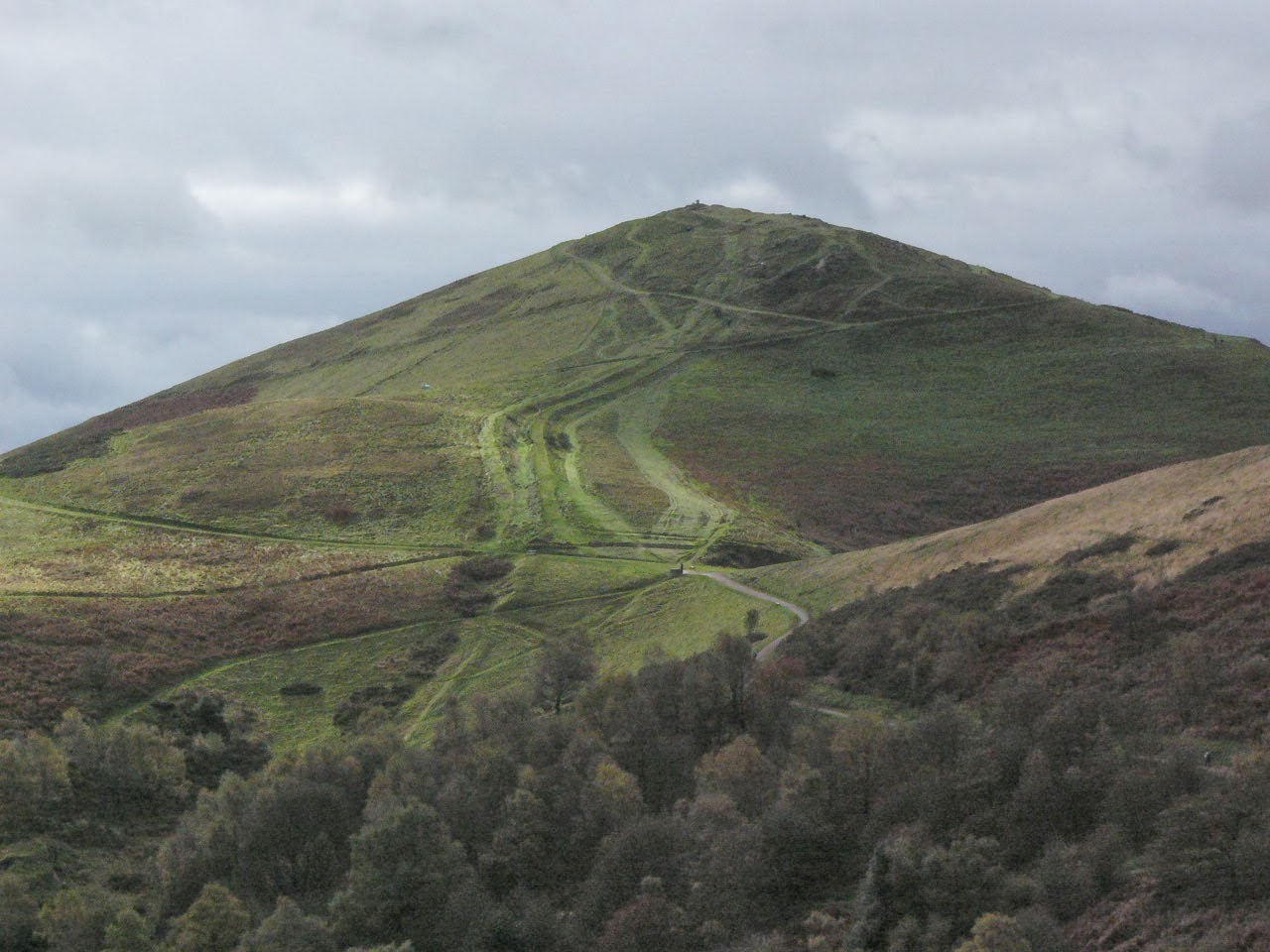
The Worcestershire Beacon.
View south along the Malvern Hills.
Although I didn't see so much in the afternoon bird-wise, the changing weather conditions meant the views of the surrounding countryside were constantly transforming in spectacular fashion! I found this fungus but am rubbish at fungi identification, something else to work on!

Unknown fungi!

I also had a look at another of the sites where Ring Ouzel had been reported, Dingle Quarry, but again with no luck, although I did enjoy great views of a hunting Kestrel overhead.

Upper Dingle Quarry.
My route back down into Great Malvern took me once again down Happy Valley - a Sparrowhawk and juvenile Stonechat on the way were nice sightings, and although there was no Ring Ouzel in sight, a Fieldfare was still at the top of the same Rowan tree that I'd seen one in earlier with the Bramblings - wonder if it was the same one? There were plenty of berries there to eat so I suppose it'd have no reason necessarily to move on!

Stonechat record shot.

I got the 17:10 train back to Birmingham University (conveniently 25 minutes' walk from my house) and was feeling pretty sleepy by the time I got home, so we chilled out in the evening and watched Poirot, enjoyably daft stuff. What a great day!

Sunday, 2 June 2013

OU field trip to the Malverns

I've had a very busy few days hence the lack of drawings. One of the things I've been up to was a field trip yesterday to the Malvern Hills, as part of the OU module I'm currently studying towards my degree. We don't get much in the way of field trips due to the whole distance learning thing, but they are always highlights - really enjoyable and anything learnt seems to stick in my head a lot better than if I'd read it from a textbook. I didn't do any drawing, no time for that! But I learnt some new plants so thought I would do a quick post about them.

We went up to the Herefordshire Beacon first and had a look at the landscape, along with info about the geology, to work out how it had influenced the surrounding landforms. The Malvern Hills are a ridge of mostly intrusive (coarse-grained) igneous Precambrian rocks that formed as part of an ancient volcanic island arc, they are some of the oldest rocks in England, AWESOME! There are also some slightly more recent (Ordovician) extrusive (fine-grained) volcanic rocks toward the southern end of the ridge, here is a cave there that has been created by quarrying basalt.

Supposedly this cave is called the Giant's Cave. I can however confirm that the person standing in it is of normal stature.
Also towards the southern end, some of the rocks have been deformed into a gneiss-type texture by metamorphism, we didn't get to see these so I really want to go back and check them out, I love metamorphic rocks!

After that we did a bit of surveying of the plants growing on the slopes, this was my favourite bit! The plants were all really small due partly to the fairly thin soil and grazing, I liked how the more closely you look, the more different types of tiny plant you could find. I don't know much about classifying vegetation types yet but it seemed heath/grasslandish, fairly neutral and dryish. Some of the plants we found there were Wild Thyme (Thymus polytrichus), Sheep's Sorrel (Rumex acetosella), Lady's Bedstraw (Galium verum), Mouse-ear-hawkweed (Pilosella officinarum) and Common Rock Rose (Helianthemum nummularium). Another group were also doing a transect down the slope to see how the soil depth varied, I had a go with the auger on a hummock near the bottom of the slope, the soil was pretty deep there!

In the afternoon we relocated to Castlemorton Common where we had a go at measuring the cross-section of a stream, and the speed of its flow, before some more plant surveying. This was more of a damp meadow, there were lots of rushes and things and some pretty confusing buttercups! I found what turned out to be a Bulbous Buttercup (Ranunculus bulbosus) while we were eating lunch, and some other plants we came across were Greater Bird's-foot Trefoil (Lotus pedunculatus), Common Mouse-ear (Cerastium fontanum), Ribwort Plantain (Plantago lanceolata) and Tormentil (Potentilla erecta).

Mouse-ear-hawkweed (Pilosella officinarum) and Heath Bedstraw (Galium saxatile).
Tiny Sheep's Sorrel (Rumex acetosella)!
Yarrow (Achillea millefolium), Germander Speedwell (Veronica chamaedrys), and Wild Thyme (Thymus polytrichus).
Common Rock Rose (Helianthemum nummularium).