Pages

Monday, 23 February 2015

191. Common Crane (Grus grus)

Common Cranes are still a rare sight in most of the UK, having formerly been more widely distributed here before their decline and extinction due to habitat loss and hunting. Now they are on the increase again, slowly, and there are resident populations in several parts of England. Some originated from continental Europe, and one colony was bred in captivity and released as part of the Great Crane Project. Although the UK's population is resident, across much of their range Common Cranes are migratory, breeding in swamps, marshes and bogs and along rivers in boreal forests across central and northern Europe, central Asia and Russia. They winter in parts of southern Europe, north Africa, the Middle East, India, Pakistan and the Far East. In the UK they are generally associated with reedbeds and wet meadows. Common Cranes are large and graceful birds which can appear similar to Grey Herons in flight, but are easily told apart by their outstretched head and neck - Herons tuck theirs in. They have an excellent trumpeting call and perform spectacular dancing displays, which strengthens the lifelong bond between pairs, but is also carried out by lone Cranes and flocks.

Common Crane, ©Comfortably Numb, via Flickr Creative Commons.
Common Crane painting.

Haha I got overexcited about starting painting again and chose a slightly ambitious image to work from, with mixed success!

Soggy times at Sandwell Valley

Yesterday it was once again time for my monthly volunteering jaunt at RSPB Sandwell Valley. With dreadful weather forecast for the afternoon it was with a small amount of trepidation that I headed off there, expecting to most likely be heading home early due to the rain!

At least it was fairly pleasant in the morning; as I walked down to the hide I heard many birds singing including Mistle Thrush, Greenfinch, Chaffinch and Robins-aplenty. Around near the feeders there were loads of Bullfinches and I also heard Willow Tit calling. It was great to see the progress that has been made on the new visitor centre - I hadn't seen it since December and things had moved on quite significantly:

   
The roof is starting to appear!
Down in the hide it was rather chilly, and fairly quiet both bird- and visitor-wise. Don't know where all the Lapwings had gone but there were hardly any in the vicinity! There were plenty of Snipe around though, a Little Grebe bobbing around at the far side of Forge Mill Lake, and Great Crested Grebe further out along with the Tufted Ducks, Gadwalls and Goosanders. There was one Common Gull hanging out with the Black-Headeds, and we had a Kingfisher fly-by past the hide. I tried to do a few drawings before the rain arrived:

The Gadwall swam off before I was able to get any further! Quite pleased with the Lapwing and Starling; I blame the vagueness of those Goosanders on the fact that the rain had commenced by that point so they appeared somewhat indistinct.
Beyond around midday, the rain and wind became heavy and relentless, and this was unfortunately our view for the rest of the afternoon!

Soggy.
The rain did at least provoke the Snipe into a frenzy of feeding activity, and we counted up to 15 probing around in the mud for worms and other tasty morsels. There was for some reason an influx of Wigeon too, Pete the Snipe had counted 7 in the morning but a bunch more came in taking it up to 23. The Oystercatcher pair which have bred every year for the past few years also put in an appearance. The wind badly affected a pair of Mute Swans that flew in from the east; one of them made the lake with no problem but the other was blown into the tall willow trees on the bank and tumbled down through them in an undignified manner! It all got a bit tense, as not only were the pair separated, but the particularly angry resident male Mute Swan known to regulars as Attila the Swan soon charged down the lake to see off the intruder - he can't tolerate any others on his patch. He chased the other poor swan all the way down the lake and back up again, just as its partner was emerging from the undergrowth looking none the worse for wear for its messy landing. It took one look at the situation and took off, following the other swan which was already beating a hasty retreat with Attila hot on its heels. 

As expected, the rotten weather meant that we had zero visitors that afternoon, so we closed the hide early and headed home! Fingers crossed for better weather next month....

Friday, 20 February 2015

190. Purple Swamphen (Porphyrio porphyrio)

Purple Swamphens may also be known as Purple Gallinules (not to be confused with the American Purple Gallinule) or Purple Moorhens, and are indeed related to the more familiar (to those of us in the UK) Moorhen. In fact they look a bit like a massively souped-up Moorhen, maybe what a Moorhen might look like in a dream it had in which it was a superhero. Purple Swamphens are nearly twice the size of Moorhens, with purple-blue plumage, a large red bill with forehead-shield and pinkish-red legs. Juveniles are more of a slatey blue-grey colour. The one in the image below is actually the African subspecies madagascariensis which has a green back and is found in Egypt (as well as various other parts of subsaharan Africa); the subspecies porphyrio has a blue back and is found in parts of Spain, Morocco, Algeria, Tunisia, and on some Mediterranean islands. Further subspecies continue the Purple Swamphen's range in tropical and subtropical regions right across to several islands in the south-west Pacific. Its preferred habitat is fresh or brackish water in marshes, lake edges, swamps and damp pastures, with dense emergent vegetation such as reedbeds, bulrushes and sedges on which it can climb about.

Purple Swamphen (Porphyrio porphyrio) ©Derek Keats via Flickr Creative Commons.
Purple Swamphen painting.
Hurrah! I've started painting again :o) My thumb is feeling much better these days, I never did get a steroid injection in the end as the pain has become very mild and intermittent after I got an awesome ergonomic mouse and keyboard at work. So I thought I'd recommence my painting, I'll see how I get on - hopefully it won't aggravate my thumb again. Quite pleased with this painting despite being a bit out of practice, it was very nice to be using some bright colours for a change (I've nearly run out of brown from doing all the raptors). Very tricky to get that shade of turquoise right though.

Things are pretty busy with me at the moment, I'm in the final year of my degree now (exciting!) so it could get intense, also I am finally learning to drive, and alongside volunteering at Sandwell Valley I've also been building and maintaining a website for a new group I'm involved with, the Friends of Rowley Hills. We'll see how many paintings I can fit in around all that!

Monday, 9 February 2015

Signs of spring at Potteric Carr

Yesterday I was once again off on my monthly jaunt with the West Midland Bird Club, this time to Potteric Carr nature reserve near Doncaster. I like going there as it's a return to my Yorkshire homelands, and as such my parents (who still live in York) usually swing by to meet me there. Today the plan was to meet them for lunch at the restaurant then enjoy a pleasant stroll round the reserve in the afternoon.

We arrived a bit before 11 and set off around the Decoy Marsh. With nothing much on the water except for a pair of Mute Swans smashing through the ice (resulting in some weird and cool sounds), we instead concentrated on the woodland where we were soon enjoying a multitude of small cute birds! As well as Blue and Great Tits, we found a Coal Tit and flock of Long-tailed Tits; also a Treecreeper and best of all some very confiding Goldcrests, which fed for ages in the Alders and Birches right next to the path, lovely stuff! We continued on but didn't see much from the next hide apart from a Buzzard, due to the marsh being frozen. The reedbeds did look marvellous in the low sun though.

Common Reed (Phragmites australis) seedhead.
Reedbed.
Then I received a text from my Dad saying they'd arrived, so I ambled over to the restaurant. While waiting for them to arrive I saw a Jay in the willows near the feeding station, and a female Pheasant crashing around in the undergrowth. Soon my parents and I were enjoying our packed lunches out in the sun on the picnic benches - the weather was lovely, I had been anticipating much colder temperatures but was able to forego my hat and mittens! It was great to see my Mum and Dad and to catch up with them :o) They brought be this book which my Mum had found in the charity shop where she volunteers, should come in handy for European adventures!


After lunch we headed down to the main marsh area, stopping via the bridge en route to see if we could see a Kingfisher - alas not, but never mind as we would be passing that way again later! We found some Snipe from the Piper Marsh hide, along with Grey Heron, Shelduck, Shoveler, Lapwing, Teal and Pochard. Further on we spotted several Little Egrets. We caught up with Andy and Mike in the 360° hide where they pointed out a Pintail and a Common Gull that they'd found. I also attempted a couple of drawings.

I started well with the sleeping Greylag, but things went progressively downhill from there!
From there we continued along the path, parallel to a bank which must have provided a warm microclimate for plants as we discovered flowering Colt's-foot and Common Field Speedwell (I think):

Colt's-foot (Tussilago farfara).
Common Field Speedwell (Veronica persica).
From the next hide we added Stock Dove, Wigeon and a pair of Little Grebes; I also attempted some digiscoped photos of which this was probably the best attempt.

Lapwings and Teal in the winter sun.
Continuing onwards we spotted a female Kestrel hunting over the rough grassland, and then managed to track down a singing Song Thrush obscured in thick Hawthorn. As we headed towards the bridge we saw a few other West Midlands birders there - they were watching a female Kingfisher. She flew off pretty soon after we arrived, but before long she was back again and we all had super views of her sitting on the branches over the middle of the stream for a good long time. My parents were dead pleased as it was the best view of a Kingfisher they had ever had.

One of the bridges where Kingfisher may be seen.
Spot the Kingfisher!
Finally we stopped off at the feeding station where the light from the setting sun was pretty spectacular. Although we hadn't seen much out of the ordinary bird-wise, I had had a great time spending the day outdoors in lovely winter weather with both my usual birding buddies and my parents! Good times :o)

View from the feeding station hide.

Monday, 2 February 2015

Sparrowhawk studies

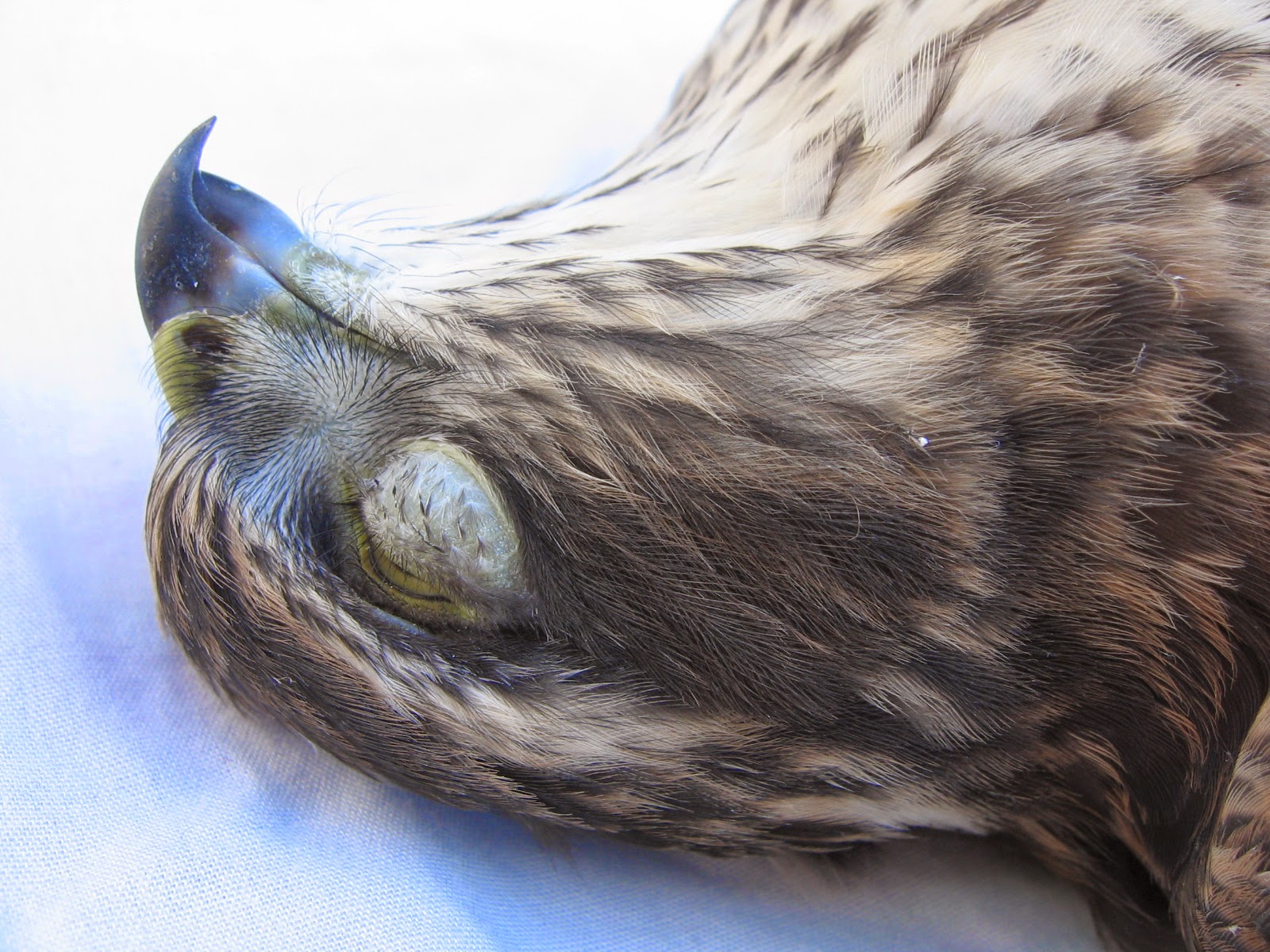
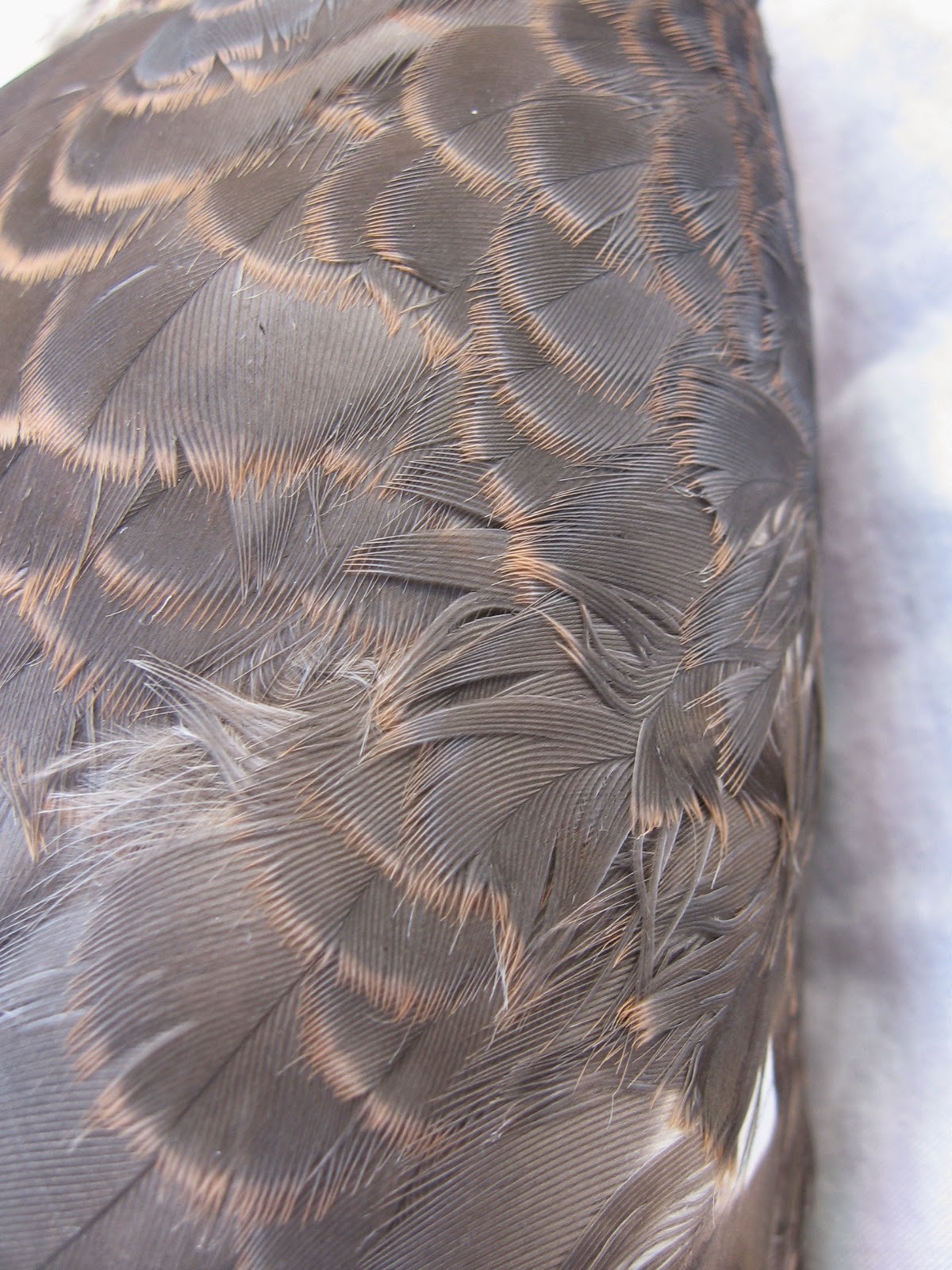
Quite a while ago now (last July), one of my work colleagues found a freshly dead juvenile Sparrowhawk outside our offices, which appeared to have flown into a window (its neck was broken). While this was sad, it was a great opportunity to get much closer than would normally be possible and to try drawing this beautiful bird, so I bagged it up and took it home to my freezer (to the consternation of my work colleagues, and also my partner Chris).

Here are a few photos to begin with!


It's taken me a while to get round to finishing my drawings and paintings due to Life getting in the way, but I finally completed the last one this weekend, and buried the poor hawk in my garden. Even though it was dead and obviously didn't care either way, I felt kind of bad about keeping it in my freezer for so long - every time I got him out, the sight of his poor stiff frozen body made me feel a little sad. I guess I am just a bit of a softy! Maybe that was why I found that actually, I didn't enjoy drawing and painting the Sparrowhawk as much as I thought I would - although it was a great chance to really closely observe the details of his feathers and structure of his body, I found it a very different experience to copying a photo of a living bird, or trying to sketch birds from life. The closed eyes and lifeless pose made a much bigger difference than I was expecting.

As I'd never attempted to draw or paint from a dead bird before, I tried a few different approaches, in both pencil and watercolour. Initially I was very unsatisfied with the results but after a few attempts was able to do something I enjoyed producing much more, and was happier with.

My first attempt, in pencil - not too pleased with this.

My second effort, switching to watercolour. I like this even less! It's 'overdone', I've slapped on way too much paint - needed to be more restrained. As it was going badly I stopped halfway through so it's not even finished.

I decided instead to focus in on small details rather than trying to draw the whole bird - these were time-consuming and I found somewhat frustrating to paint (I lack patience) but I'm happier with the results.

Back to pencil, trying to just sketch the structure of the wing feathers without adding any detail at all. I like this much better!

More watercolour details - OK but not great.

Another pencil sketch focussing on the structure of the wings without any other details - again, I like this.

Final drawing, again concentrating on structure of wing feathers. Got really into it and made the lines super-strong!
I'm glad to have had the chance to draw and paint this Sparrowhawk but I know now that I definitely prefer drawing and painting from living birds, both in photos and in real life!

Monday, 19 January 2015

Common Loon painting for a BirdingPal!

As recently recounted here, I visited Minneapolis last November and whilst there, met up with a local birder, Bob, who I'd got in touch with through BirdingPal. We spent a very full morning (commencing at dawn) visiting various fine birding spots around Minneapolis, and both the birds and Bob's excellent company made it one of the highlights of my trip. I got a fair few life ticks and wouldn't have been able to get to nearly as many different places on my own.

I wanted to send Bob a small gift to say thanks so decided to do a painting. When I asked what his favourite bird was, he said probably Common Loon (he is so Minnesota). I was very pleased about this as divers are amongst my favourite birds and I love to paint them. I worked from a photo and am pretty happy with the painting overall. The part I enjoyed painting most was the Loon's head and neck, I really like depicting iridescent plumage and specifically chose a photo that showed it well for that reason; the beady red eye is always nice too. The chequerboard back was a bit fiddly but came together at the end! So far in my paintings and drawings I haven't made much effort with backgrounds - the focus is on the bird and I am usually limited for time, also I find backgrounds much less interesting to depict than birds! However I felt I couldn't get away with that in a more 'proper' painting, so made a bit more of an effort. I'm mostly happy with the background except the water just to the immediate left of the bird, it doesn't look quite right to me - but hopefully the reflections in the foreground (which I was happier with) and the bird itself pull focus away from any shoddier bits.

The completed painting.

Framed painting.
I've sent the painting off today, so let's hope Bob likes it! :o)

Monday, 12 January 2015

First trip of the year - Rutland Water

Yesterday I was off on my first proper birding trip of the year, on the annual jaunt to Rutland Water with the West Midland Bird Club. Last year's trip had included such delights as Black-Throated Diver, Barn Owl, Black-necked Grebe and Black Redstart so we had high hopes for today.

From the coach en route to our destination we spotted several Red Kites, looking marvellous in the low sun of the early morning. I also was given unexpected gifts! Andy, ever the bargain-fan, had picked up a copy of Rob Hume's 'Life With Birds' in Poundland for me, and Phil had brought in loads of old copies of Bird Watching magazines for anyone who was interested - he'd saved me one with an article about drawing birds :o) Many thanks Phil and Andy! 

We started as usual at the dam where, although we didn't reach the giddy heights of last year's triumvirate of 'birds whose names start with Black', we nonetheless still saw a Red-necked Grebe, Little Grebe, Great Crested Grebes and Goldeneyes a-plenty, as well as the usual Mallards, Tufted Ducks and Cormorants.

Onwards to the Anglian Water Birdwatching Centre, where we had a quick peer over the fields adjacent to the car park and found a few Redwings on the ground while a friendly Robin watched us closely and a pair of Egyptian Geese flew over.


Watchful Robin.

We then spent some time in the centre, enjoying the heated viewing area - mmmm. Here our lists expanded considerably, with the addition of ducks galore (Pochard, Gadwall, Teal, Shoveler, Wigeon, Goosander, and loads of Pintail - apparently present in the highest numbers ever recorded at Rutland Water), as well as Curlew, Little Egret, Shelduck, and Lapwing. 

Then it was back out into the cold to investigate the feeders, where we saw Blue, Great and Coal Tits, Dunnock, Blackbird, Moorhen and Reed Bunting. No sign of the Marsh Tits spotted by some other members of our group earlier though....we set off for the hides around the older lagoons to see what else we might find. This turned out to include more Red Kites, Song Thrush, Common Gull, Stock Dove, Kestrel, Redshank, Green Sandpiper and four lovely Smew - a male and three females. Not too shabby! We stopped off at the feeding station again and had better luck - two Marsh Tits visited frequently, and a flock of Long-tailed Tits descended and engulfed the feeders for some time!


Couple of Long-tailed Tits, a Blue Tit and a Reed Bunting tuck in.
We then went to wait in hopeful anticipation for the emergence of a Barn Owl; while we waited a few Canada and Greylag Geese flew over, a Buzzard perched on an Osprey nesting platform, and a Green Woodpecker popped up in front of the hide. A keen-eyed member of our group found a Brown Hare lying low in the rough grassland; it had flattened itself down and was well-camouflaged, but we could see its eye peering out! I enjoyed checking in on the hare every few minutes to see if it had moved (I really like hares), it was still in place when we eventually left the hide so perhaps that was where it was going to spend the night. Alas, the weather grew increasingly dank and drizzly as the afternoon drew on, and this probably put off the Barn Owl, as we did not see one. The changing light as the sun set and the weather passed through was rather lovely though:

Out there, a hare is snuggling down for the night.