Pages

Thursday, 15 August 2013

108. White-faced Storm Petrel (Pelagodroma marina)

White-faced Storm Petrel is the final storm petrel in the Collins guide, and is the only one you could potentially see in Europe that has white underparts. It's also distinctive in having rather broad wings unlike the other storm petrels, which it can fan out into a round paddle shape, and even longer legs than Leach's Storm Petrel. Apparently if you are particularly imaginative, you could even confuse it with the phalaropes! It breeds on Madeira, the Canaries and Cape Verde Islands in the north Atlantic, and also a few other islands in the south Atlantic and Pacific; outside of the breeding season it roams these oceans and also the Indian Ocean.


White-faced Storm Petrel, ©Seabamirum, via Flickr Creative Commons.
White-faced Storm Petrel sketch.
Yet again, on the chunky side. Reckon if I just compressed it a bit vertically it would probably be spot on!

107. Swinhoe's Storm Petrel (Oceanodroma monorhis)

Although Swinhoe's Storm Petrel is very similar in size and morphology to Leach's Storm Petrel, it is told apart by its uniformly dark brown/black plumage with no white rump. This means it could also be confused with Bulwer's Petrel, but Bulwer's is larger with a longer tail generally held in a narrow point, compared with Swinhoe's shorter, forked tail. Swinhoe's Storm Petrel is usually found around East Asia, but it does occasionally turn up elsewhere, in fact I believe that there is one loitering around Fair Isle at this very moment.

Swinhoe's Storm Petrel, ©Francis Yap, used with permission.
Swinhoe's Storm Petrel sketch.

Many thanks to Francis Yap for allowing me to use his great Swinhoe's Storm Petrel photo! Hmm, I got the lower wing a bit too narrow and the body a little chunky in my drawing.

Wednesday, 14 August 2013

106. Madeiran Storm Petrel (Oceanodroma castro)

Madeiran Storm Petrels breed on a few east Atlantic islands including the Azores, Madeira and the Canaries, as well as several other rocky islands in the Pacific ocean. Outside of the breeding season they are widespread across the Atlantic and Pacific around the tropics and subtropics, and as far north as offshore from Portugal. They are most similar in appearance to Leach's Storm Petrel, but with less of a contrast between the pale upperwing patch and black wingtips, a less deeply-forked tail (although this can vary in Madeiran and it seems like it may be further split into separate species in future) and a white rump patch that appears more wide than long, and extends further under the tail than in Leach's.

Madeiran Storm Petrel, ©Martin Lofgren, used with permission.
Madeiran Storm Petrel sketch.

Thanks again to Martin Lofgren for allowing me to use another of his great photographs.

Tuesday, 13 August 2013

105. Leach's Storm Petrel (Oceanodroma leucorhoa)

Leach's Storm Petrel is fairly large as petrels go, and although it can appear similar to the European Storm Petrel, there are a few differences (aside from the size). Leach's has a long pale panel on its upperwings which contrasts strongly with their black tips, whereas the European Storm Petrel's wings are fairly uniformly blackish brown, and Leach's white rump is more v-shaped and does not extend as far underneath the tail as the European Storm Petrel's. Leach's also has a more powerful flight due to its larger size. It is widespread, breeding in the Northern Hemisphere and heading towards and beyond the Equator outside of the breeding season, reaching as far south in the Atlantic as South Africa. In Europe, it breeds on rocky coasts and islands around the north UK, Iceland and Norway.

Leach's Storm Petrel, ©C. Schlawe/USFWS, via Wikimedia Commons.
Leach's Storm Petrel sketch.

Admittedly this photo doesn't show the ID features of Leach's Storm Petrel at all well, but there weren't many with a Creative Commons license, and as you may have guessed by now I am a bit of a sucker for a cute bird photo every now and then!

Sandwell Valley - August

I was back at Sandwell Valley on Sunday, volunteering in the hide - we were a bit down on volunteers so I spent the whole day in there but I didn't mind missing out on a walk around the reserve, as there were some rather abrupt heavy showers in the morning! Always like being in a hide in the rain, a nice cosy feeling. The weather didn't put off looooooads of House Martins though, they were out in force over Forge Mill Lake, along with a couple of Sand Martins. Swifts were conspicuous by their absence though! Bird-wise, things were as expected for the time of year, pretty quiet. Highlights included a few Kingfisher fly-bys and a passage Common Sandpiper who'd been loitering for a while, it kept popping up here and there occasionally. It was also nice to see two watchful female Tufted Ducks doing very well with their creche of nine chicks - whilst on the water it was impossible to count them as they were constantly diving and resurfacing, but once they came out onto the island for a preen and a rest, we got a good look!

I know there are only eight Tuftie chicks here. This was before the last and smallest one propelled itself out of the water at high speed to join the rest!
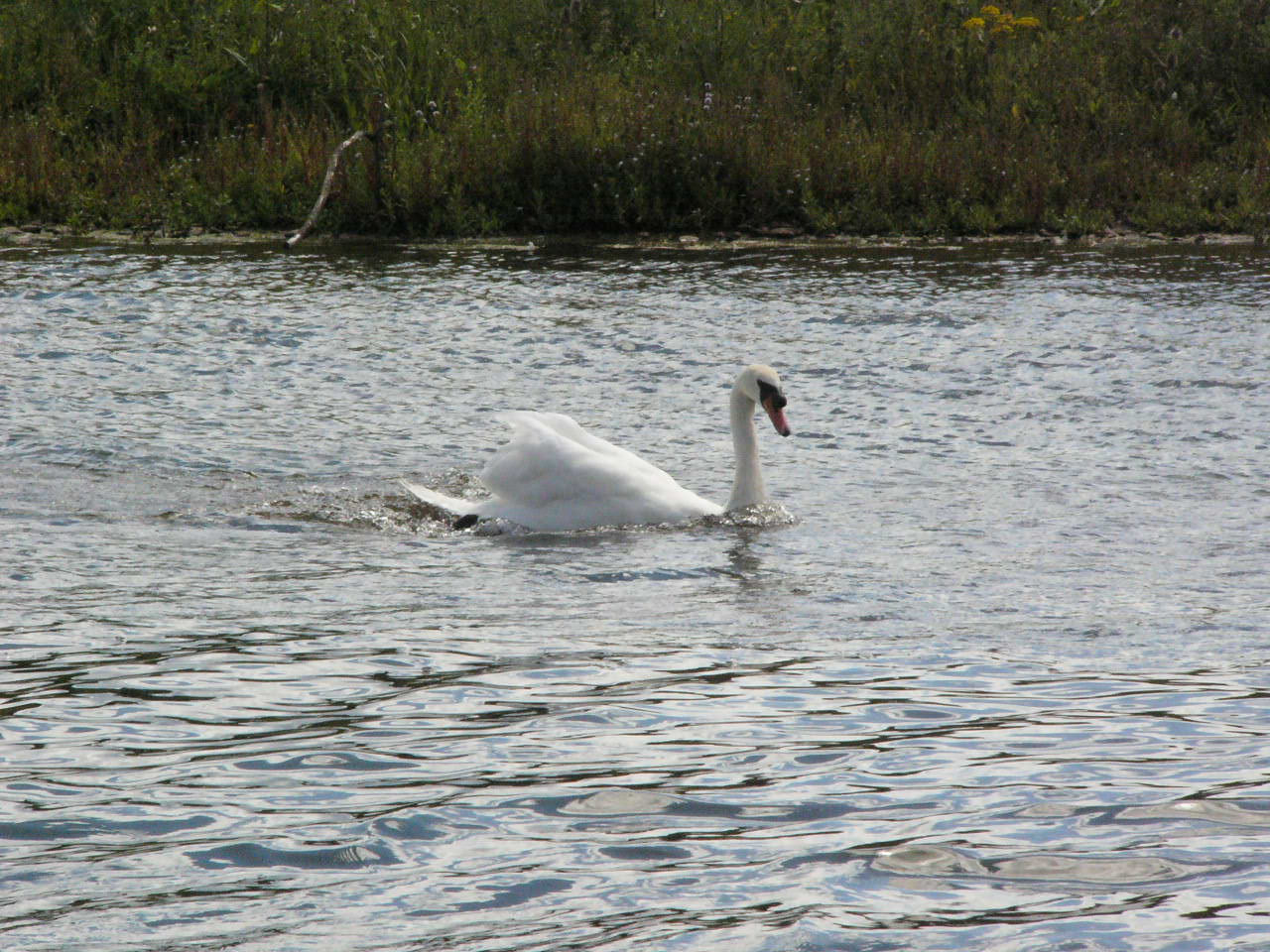
Also amusing us with its antics was a very officious male Mute Swan who was very keen to round up and herd a large group of juveniles to a certain part of the lake, for reasons unknown.

The juvenile Mute Swans paddling with some urgency past the hide......
.....followed seconds later by this big fella.
I found some more plants to try and identify:

For some reason I thought this might be something different, but I think it's just our old friend Common Bird's-foot-trefoil (Lotus corniculatus).
Growing in the damp area under the hide swingbridge, Water Mint (Mentha aquatica).

Loads of this in the grassland areas on the way down to the marsh screen, Great Burnet (Sanguisorba officinalis).

Another one growing in the damp area under the hide swingbridge, I was very intrigued by this one! After some umming and aahing I've decided it's Water Figwort (Scrophularia auriculata), due to its location and more rounded leaves (you can't see them in this photo - but I did check them!)
There were plenty of butterflies around, including Large White, Gatekeeper and these two:

Peacock (Inachis io).

Small White (Pieris rapae).

With all the House Martins around, I thought I'd have a go at drawing some - my efforts leave a lot to be desired though! Was a bit happier with my wonky/jaunty Common Sandpiper, would have liked to have done more but it disappeared and was not to be seen for the rest of the day. I spent some time on the Lapwing and quite like it although the legs are pretty shonky.

Sketches of House Martin, Common Sandpiper and Lapwing.

104. Wilson's Storm Petrel (Oceanites oceanicus)

Wilson's Storm Petrel is slightly larger than the European Storm Petrel, with no white in its underwing, a white rump which encircles the tail and almost meets underneath, and much longer legs which project beyond the tail when it's not dabbling them around on the water's surface while feeding (behaviour which is also seen in other storm petrel species). It breeds in the Southern Hemisphere on the Antarctic coast and subantarctic islands, spending the rest of its time widely distributed throughout the oceans of the southern hemisphere and as far north in the Atlantic as the waters off the southwest coast of the UK.

Wilson's Storm Petrel, ©Dan Irizarry, via Flickr Creative Commons.
Wilson's Storm Petrel sketch.

I thought I'd have a go at two birds today as I really liked this photo which illustrates well the intriguing and charming feeding behaviour of Wilson's Storm Petrel! I found drawing 2 birds quite a helpful exercise, good for extra practise and improving upon mistakes.

Friday, 9 August 2013

103. European Storm Petrel (Hydrobates pelagicus)

The European Storm Petrel is a tiny wee fellow, being the smallest of the storm petrels in these parts at around the same size as a House Martin. They are well'ard though, being completely pelagic outside of the breeding season, which they spend off the coast of western and southern Africa, and possibly in parts of the Mediterranean. They breed in burrows on rocky islands and inaccessible coasts around the western coasts of Europe and also in a few places in the Mediterranean. It can be told apart from the other petrels by the broad white band on its underwing, visible in flight (but unfortunately not the photo below!), its small size and its more fluttering, busy flight.

European Storm Petrel, ©Otter, via Wikimedia Commons.
European Storm Petrel sketch.
Quite happy with this one - wings on the short side but otherwise fairly OK :o)