Pages

Friday, 28 February 2014

172. Red-footed Falcon (Falco vespertinus)

Red-footed Falcons breed in localised areas of eastern Europe, but are more widespread further east; they winter in sub-Saharan Africa. Vagrants occur in small numbers throughout western Europe, such as the bird which delighted many at RSPB Lakenheath last year! In flight, Red-footed falcons can resemble both Hobbies as they catch insects in mid-air, and Kestrels as they will also hover to hunt small animals. The male is very distinctive with his suave blue-grey body and contrasting red bill, eye ring, legs and trousers/undertail. Females have blue-grey barred upperparts and orangey buff underparts and head with a small amount of dark streaking, and a small dark mask against white cheeks, like a Hobby's but smaller. Juveniles are similar to females but browner above, with strong streaking below, and a brown cap. Red-footed Falcons' preferred habitat is open country with stands of trees, such as meadows, river valleys, steppe and farmland.

Red-footed Falcon, ©Edwyn Anderton, via Flickr Creative Commons.

Red-footed Falcon painting.
Unusually I've made the wings a bit too slim, normally I make things too chunky! Bit tardy with this one too, it's been a busy week what with various things taking longer than expected (as is always the way), cinema and go-karting (!) trips and some impromptu trespassing on a local golf course (in an attempt to get away from street lights) to try and spot the aurora last night, alas unsuccessfully! Also I can now scan drawings once again after replacing the broken screen in Chris's laptop (my Mac doesn't talk to the printer/scanner), pleased that I have learnt how to replace a laptop screen :o)

Sunday, 23 February 2014

A spot of urban birding in Barcelona

Last week Chris and I went on a wee holiday to Barcelona - it was our Christmas present to one another instead of stuff, which we have enough of already. Chris isn't too into birds so it wasn't a birding holiday, but I was excited to see whatever I might come across, and hoping for a few lifers as the majority of my European birding up until now has been north of the Arctic Circle :oD

Unsurprisingly the first birds we saw were Feral Pigeons, Common Starlings and Yellow-legged Gulls. However it wasn't long at all before we came across the first of many Monk Parakeets - these noisy guys are in pretty much every tree in Barcelona, even on the busiest roads.

Monk Parakeets in Park Güell.
Monk Parakeet in Parc de la Ciutadella. This one and several of its associates were wearing little neck tags which I think are part of a project studying the dispersal of Monk Parakeets.

I read somewhere that there are 6 species of parakeet in Barcelona, all feral populations - I managed to find 3, as well as the Monk Parakeets we also saw some Rose-ringed on La Rambla, and a good-sized flock of Red-masked Parakeets in Parc de la Ciutadella which was a new species for me.

Parc de la Ciutadella, near to where we saw a flock of Red-masked Parakeets in a large coniferous tree.
In the two parks we visited, we saw plenty of everyday (for us at least) birds - Blackbird, Chiffchaff, Blackcap, Collared Dove, White Wagtail, Great Tit, Blue Tit, Robin, House Sparrow, Chaffinch, Jackdaw and Magpie. It was dead exciting to see so many Black Redstarts, they weren't wary at all and we watched one female sitting in a nearby bush in Park Güell for some time.

Spot the Black Redstart!
Park Güell is a most excellent park, with the joyful and intriguing Gaudí architecture of the busier 'monumental zone', and the quieter, richly vegetated wider park area, which is hilly in places giving brilliant views over Barcelona, and where more birds could be found. Just by where the Black Redstart above was, I saw my first Crested Tits - deep joy!

Park Güell monumental zone.

Park Güell.
View over Barcelona from high up in Park Güell.
My first Crested Tits were in this tree :o)
Other lifers included Serin, seen while we were wandering round the city, Spotless Starling which we saw in Parc de la Ciutadella (another top notch park!) and Audouin's Gull, a super-smart gull which could be seen flying around over the sea at the beach.

The beach!

The beach!
There was also something of an owl theme to the trip, not because we saw any but (to begin with at least) because this was my holiday reading:

'Owl' by Desmond Morris, an anniversary gift from Chris!
It was a very enjoyable and accessible read about owls in human culture, which also unexpectedly enhanced our holiday by alerting us to the existence of this mighty owl!

This is supposedly one of the largest owl images in the world! It is on top of a building located at the junction of Avinguda Diagonal and Passeig de Sant Joan in central Barcelona, and was erected as an advertisement for a company that installs neon lighting. Although apparently it doesn't light up any more.
Later on in the book was a large section about Picasso's works featuring owls, which was also fortuitously timed to coincide with our visit to Museu Picasso. I vaguely remembered from A-level art, my art foundation course and previous visit to Barcelona with said course that Picasso had depicted owls but had since kind of forgotten about it so these images filled me with the joy of rediscovery, as well as the joy of just seeing pictures of owls!

Pablo Picasso - Still life with owl and three urchins (1946).

Pablo Picasso - Owl in an interior (1946).
Also in Museu Picasso, I enjoyed his series of paintings of a pigeon loft, they were filled with light and colour, I can imagine the pigeons cooing and bumbling around their peaceful loft in the Mediterranean sunshine.

Pablo Picasso - The pigeons (1957).

Picasso's work is so varied, I think there is something for everybody :o)

Saturday, 22 February 2014

Sandwell Valley - February 2014

Last Sunday I was once again volunteering in the hide at RSPB Sandwell Valley (this blog post concerning it being somewhat late due to intervening computer issues and a wee holiday in Barcelona!) It was my new scope's (Nikon ED50) first outing so I was dead excited to be trying it out, and to also try my luck with my first attempts at some digiscoping too.

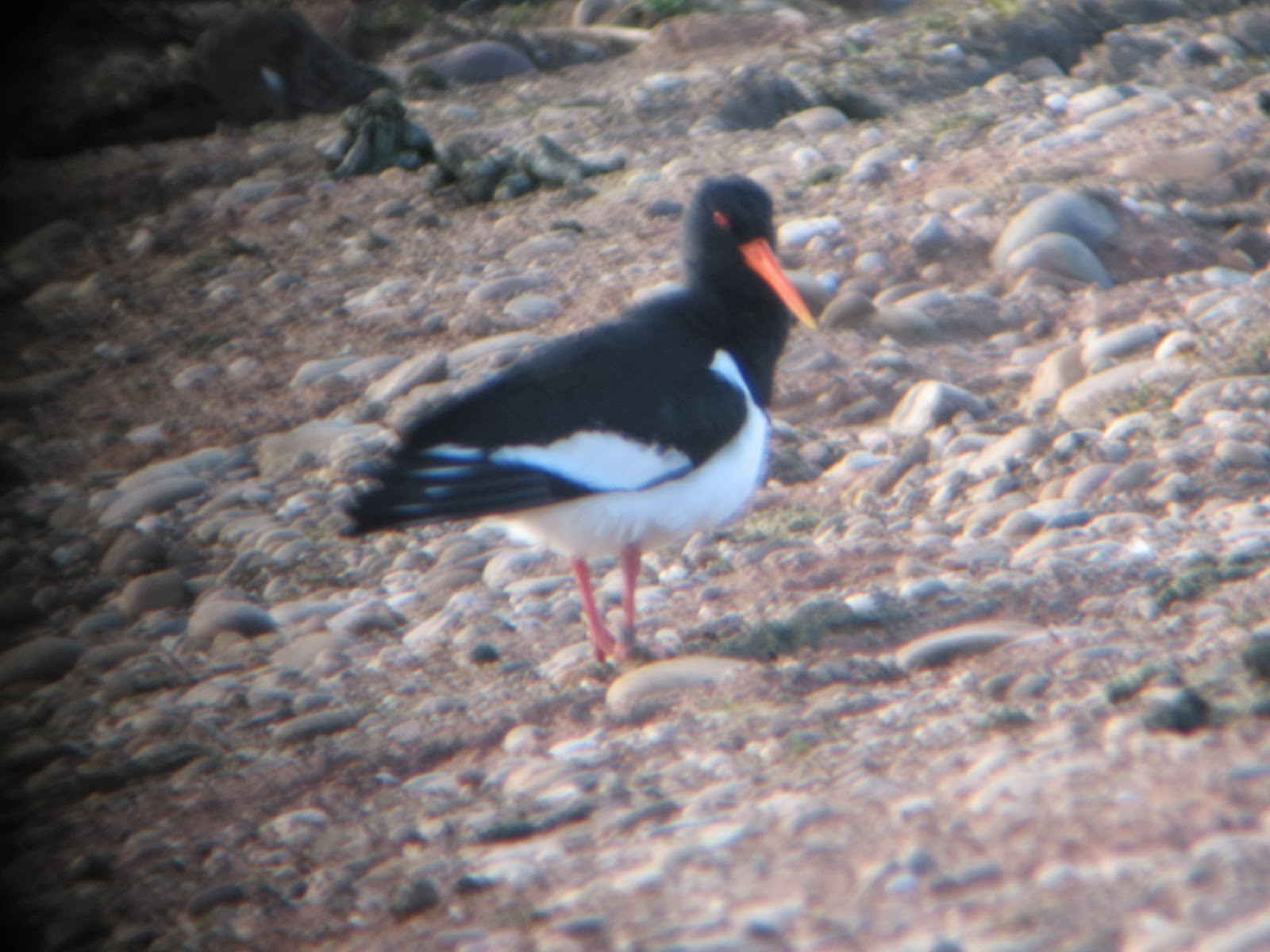
At the reserve the water levels were very high after all the recent rain, bird-wise it was on the quiet side, however the Oystercatchers had recently returned so it was good to see them back - hopefully they will breed again successfully this year. It's the same pair we've had over the past few years, they're easy to recognise as the female only has one foot so is nicknamed Stumpy! She seems to get by well enough, it only causes her problems when she tries to scratch her head with her remaining foot which usually results in a bit of a tumble. Here are some digiscoped attempts at the Oystercatchers!


Digiscoped Oystercatcher.

Digiscoped Oystercatcher.
Haha, kind of shoddy - I think (well I hope) that the main problem was not enough light in the hide - my camera (ancient Canon Powershot A520) is a reliable friend in good light conditions, but anything suboptimal makes it wobble around all over the place and a steady hand indeed (or a tripod) is required. I don't have a digiscoping adaptor currently, I was bewildered by the range on offer when I did a bit of Googling so thought I'd try without one to begin with before shelling out (or just fashioning something out of a loo roll tube and gaffer tape). Here's another one of a Cormorant:

Digiscoped Cormorant.

A highlight of the day was the loads of Snipe resting, feeding and bathing on the islands in front of the hide, here's my best attempt at a digiscoped pic of them:

Digiscoped Snipe.
Not great! But my new scope also made sketching a bit easier, and the Oystercatchers and Snipe provided some good opportunities. I've mainly stuck to easier resting poses again where the birds keep relatively still, although I tried to do lots of quick sketches of the Snipe as they were moving around a bit more, which I quite like.

Oystercatcher sketches.

Snipe sketches.
Next time I will have to attempt digiscoping outdoors in better light :o)

Friday, 21 February 2014

171. Lesser Kestrel (Falco naumanni)

Lesser Kestrels are summer visitors to various patches of southern Europe, mostly around the Mediterranean; they winter in sub-Saharan Africa as well as further east. They can be difficult sometimes to tell apart from Common Kestrels - the male (shown in the photo) is quite distinctive, having only small sparse spots on his breast and lacking the black spots over the wings and moustachial stripe that Common Kestrel has. He also has a blue-grey panel in his wings, between the rusty back and black wingtips. Females are harder though, the slightly paler cheek in Lesser Kestrel can be a clue. Juveniles are also tricky; first-summer birds may appear very similar to Common Kestrels as they have black spots on their coverts and tertials, and no blue-grey wing panel in males. They have slightly shorter wings and tail than Common Kestrel but still appear graceful in flight, usually only hovering for short periods compared to Common Kestrel's longer hovers. Lesser Kestrels like dry open lowland areas (semi-desert, farmland and grassland) often with cliffs, old buildings or ruins that they can nest in.

Lesser Kestrel, ©Ian N. White, via Flickr Creative Commons.
Lesser Kestrel painting.
I've made his eye and bill a bit on the large side, he's a bit cartoon-ish. Bit tardy posting this, as Chris was having a crisis with his laptop when I painted it last weekend so I couldn't scan it (the laptop screen is on the way out - we're going to have a go at replacing it, Google says it looks do-able!) - then during the week we were in Barcelona which was great :o) more to come on that!

Thursday, 13 February 2014

170. Common Kestrel (Falco tinnunculus)

Common Kestrels are a familiar sight in the UK and Europe, being the most common falcon in these parts. I see them frequently from my office window at the University of Birmingham, in fact only today I spotted one a couple of times. They are resident throughout much of southern and central Europe and north Africa, and are found in Scandinavia only in summer. Their hovering flight is distinctive, I really like this photo which I think illustrates it perfectly. Both sexes have rust-red upperwings and back, with black wingtips; the female's rusty colour is slightly browner than the male's. They are boldly speckled with black spots and have a grey head and tail which again in the female is slightly browner; she also has barring on the tail. Juveniles look similar but are more streaky than spotted. They like a wide range of open habitats, including farmland, grassland, heathland, motorway verges and marshes, with some trees or buildings for nesting.

Common Kestrel, ©ferran pestaña, via Flickr Creative Commons.

Common Kestrel painting.

Argh I spent way too long on this but lost patience in the end and bodged up the underside of the wing somewhat, still I think the rest of it is OK, I'm quite pleased with the shape. Really need to try and stick to my time limit and not get carried away! Especially seeing as my studying has gone up a notch now I'm doing 2 modules at once (Ecosystems and Evolution).

Sunday, 9 February 2014

169. Black-winged Kite (Elanus caeruleus)

Black-winged Kites are found in a few areas of northern Africa, Spain and even France, how exciting! They are pretty unique-looking with their red stare and grey, black and white plumage; they are Hobby-sized but bulkier with a larger head, and can hover like a Kestrel and glide like a harrier. The sexes are similar and juveniles have a less blue-tinged grey back with white feather tips, and an ochre-brown tinged breast and crown. They like open habitats, such as savanna, semi-desert, forest fringes and plains interspersed with trees and copses.

Black-winged Kite, ©srikaanth.sekar, via Flickr Creative Commons.
Black-winged Kite painting.
No painting tomorrow as I'm rushing off to London now, for the British Ecological Society's Undergraduate Ecological Careers Event tomorrow, woohoo! I should learn loads of useful stuff to help me get an ecology-based career :o)

Saturday, 8 February 2014

168. Dark Chanting Goshawk (Melierax metabates)

Dark Chanting Goshawks are mostly found in sub-Saharan Africa, however there is a very small and sadly dwindling isolated population in the Western Palearctic, in a very small area of Morocco. Unlike the other sparrowhawks and goshawk, Dark Chanting Goshawks like to perch high up in exposed prominent places to look out for prey, which allows for some great photo opportunities - no trouble finding a photo today! They are kinda funny-looking to my mind, with long legs which are red, as is the bill. The sexes are alike, and the adult plumage is grey with black wing-tips and a pale rump, somewhat like a male Hen Harrier, but broader-winged and with a rounded tail tip and black centre to the upper tail. The juvenile plumage is brown above, streaked on the breast and coarsely barred on the belly. The flight is like that of an accipiter hawk - flap flap flap glide. Their preferred habitat is open parkland, savanna, semi-desert and cultivated areas.

Dark Chanting Goshawk, ©Frank.Vassen, via Flickr Creative Commons.
Dark Chanting Goshawk painting.
Tricky to get that shade of grey quite right.