Pages

Sunday, 20 April 2014

Easter Malvern magic!

It's the Easter holidays, wahey! For me that means a full 6 days off work as Birmingham University closes til the Thursday after Easter, good times. It's a good chance to get loads of studying done but also when the weather is good (which seems to have finished now) to get out and about, so on Friday Chris and I headed to one of our favourite destinations, the Malvern Hills. After my previous visit to the southern end of the hills, we decided to return there to explore a bit more of the area. It was a brilliant day! As I've previously mentioned, one of the great things about the Malverns is the range of habitats you can see in a very compact area. Here are some of the different landscapes we experienced on our walk!

Looking north up the Malvern range, the tallest one in the distance is the Worcestershire Beacon.
The terraced hillsides of the Herefordshire Beacon/British Camp.

Blue water at Gullet Quarry.
Awesome geology at Gullet Quarry! Unfortunately it's too dangerous to get close up to the rocks for a proper look :o(
View from Castlemorton Common.
Castlemorton Common (with a Buzzard).
Castlemorton Common. I heard a distant Grasshopper Warbler in this area but did not see it!
The obligatory cute lambs photo.
Walking back up towards the British Camp Reservoir.
Highlights of the day included seeing my first Redstarts and Whitethroats of the year, a super-cool Peregrine and friendly Raven both perching and flying around Gullet Quarry, and a rustling among dead leaves on a bank to one side of the path which revealed itself to be a Bank Vole. We also saw 6 butterfly species (Comma, Orange Tip, Green-veined White, Peacock, Small Tortoiseshell and Speckled Wood).

Raven (and Jackdaw!) at Gullet Quarry.

Small Tortoiseshell (Aglais urticae) butterfly on Nettles (Urtica dioica).
I was as usual on the lookout for plants to attempt to ID as well:

I'm not too sure, but I think this might be Hairy Sedge (Carex hirta). Edit: no it's Field Wood-rush (Luzula campestris)! Laughing and learning....(mainly learning).
Here is some very small and cute Germander Speedwell (Veronica chamaedrys)!
Hmmm this is most probably Common Dog-violet (Viola riviniana) but I should've had a closer look at it to check it isn't Early Dog-violet (V. reichenbachiana).
Erm. At first I thought this was Bugle (Ajuga reptans) but the more I look at it the more I think it might be Ground Ivy (Glechoma hederacea). If anyone is more certain do let me know!
Greater Stitchwort (Stellaria holostea).
We finished off our day by stuffing our faces with delicious food in The Nag's Head in Great Malvern, before heading home to watch The Muppets film. What a superb day!

Monday, 14 April 2014

Sandwell Valley - April 2014

Yesterday was my monthly volunteering jaunt at RSPB Sandwell Valley; I was looking forward to it as many new Spring friends had arrived since I was last there! Indeed on my walk down to the hide I heard and saw many fine things, including singing Chiffchaff, Willow Warbler and Blackcap, and Peacock, Comma and Orange Tip butterflies.

Peacock Butterfly (Inachis Io) in the wildlife garden area.
The marsh and Forge Mill Lake looking fine!
Comma butterfly (Polygonia c-album) on Blackthorn (Prunus spinosa). Those Orange Tips were too quick to photograph though!
Down at the hide, the Oystercatchers appeared to be incubating eggs - they had cleverly chosen as their nest site a small area that had been fenced off to try and protect nesting waders from the marauding tramplings of Canada Geese. This doesn't appear to have been entirely successful as there was also a Canada Goose sitting withing the fenced area! However the Oystercatchers weren't fazed by the geese, and maybe it will prove a wise choice as the geese could assist with chasing off predators. During the day we saw the male and female swap over a few times, taking turns to sit on the eggs. Something they definitely were fazed by were the several juvenile Grey Herons which flew overhead a few times - this was guaranteed to set off the Oystercatchers a'squawking.

Nesting Oystercatcher, with an attendant Canada Goose. My digiscoping efforts I think are slowly improving :o)
I also saw my first Swallows, Sand and House Martins of the year. During the day we saw a pair of Great Crested Grebes swim right past the front of the hide a couple of times, possibly searching for nest sites - at one point they briefly investigated an old Coot's nest very close to the hide, but seemed to decide against it - probably for the best as it is rather exposed and shoddily constucted! Another Great Crested Grebe pair were seen further down the lake, possibly building a nest beneath some overhanging trees.

Don't nest there, it's shoddy.
Nearly all the winter ducks have gone now, there were a small handful of Goosanders about and someone reported that they had seen a pair of Shoveler on the marsh. The confused Pochard that thinks it's a Tufted Duck was still there though - he normally stays all year round with his tufted friends.

I'm a Tufted Duck! I'm a Tufted Duck! I'm a Tufted Duck!
I had fun practicing my digiscoping on the Lapwings:

This was probably the best one.....only a tiny bit of vignetting...
And also the Little Ringed Plovers! Despite numerous attempts this was about the best I managed, it's no coincidence that it's of one of these normally busy plovers sitting still for once:

Digiscoped Little Ringed Plover....shame it's not quite in focus!
However I am quite pleased with some of the day's drawings, as well as the 3 Little Ringed Plovers there was also a Common Sandpiper bumbling around.

Little Ringed Plover and Common Sandpiper sketches. The Little Ringed Plover on the left hand page is my favourite. I was trying, but not quite succeeding, to nail the head patterns in the two bottom right sketches.
On the path down to the hide, I tried to look out for interesting new plants to attempt to ID. It's more difficult when not much is in flower, although not new to me I saw some lovely Cuckoo Flowers:

Cuckoo Flower (Cardamine pratensis).
And these leaves which were a bit more mysterious:

I'm going to hazard a guess at..... Creeping Cinquefoil (Potentilla reptans). Might have to wait until it flowers though for confirmation!

I also spotted a white butterfly and I can't decide whether it was Small White or a female Orange Tip, my butterfly ID skills are still in their infancy! I'm inclined to think Orange Tip due to the time of year (a bit early for Whites?), unfortunately this is not a good photo, but if anyone can tell from this picture I would welcome that! :o)

Male Small White (Pieris rapae) or female Orange Tip (Anthocharis cardamines)?

Also in other news, I finally took my thumb to the GP this morn, who diagnosed De Quervain's tenosynovitis, likely to be brought about by my intensive note-taking with poor writing technique from my studies. The best course of action is definitely resting the area completely so I am going to stop my paintings again for a while as I really want this to recover now (if it doesn't, the next step is steroid injections and I don't like the sound of that!) So alas, there will be no paintings for a while and I will be using the time instead to ice and stretch my thumb!

Friday, 11 April 2014

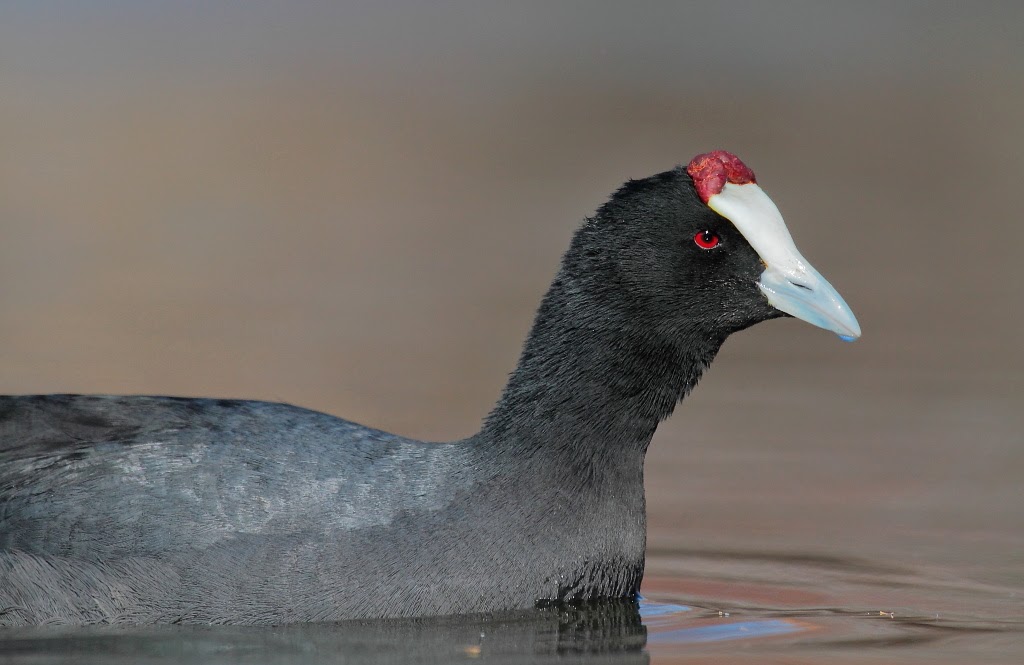
189. Red-knobbed Coot (Fulica cristata)

Red-knobbed Coots are found in a few very localised spots in Morocco and Spain, inhabiting the same kind of habitat (and often alongside) Eurasian Coots. They can be very hard to tell apart at a distance, even more so outside the breeding season when the red knobs shrink! The blue tinge to the bill is a clue, and the feathering adjacent to it does not form a pointed wedge into the upper mandible as it does with Eurasian Coot. In flight its wings do not have a white trailing edge (as Eurasian Coots' do) and on the water their bodies appear less smoothly rounded, with a raised squarish rump.

Red-knobbed Coot, ©Agustín Povedano, via Flickr Creative Commons.
Red-knobbed Coot.
Hmm, proportions of the head and bill are rather wonky. I quite like the texture on the neck though.

Thursday, 10 April 2014

188. Eurasian Coot (Fulica atra)

Eurasian Coots are another very common waterbird of lakes, reservoirs, ponds and slow-moving rivers, with a very similar distribution to Moorhens. In the UK they are resident but their numbers are swelled in winter by birds that have migrated from further north. They are sometimes confused with Moorhens but are easily distinguished by their white bill and head-shield, larger more rounded body with no white markings, and more aggressive behaviour - Moorhens are rather shy and retiring in comparison. If you get a look at the feet too, they are also very different - Moorhen toes are long, slim and yellow-green, but Coot toes are long and pale grey with big lobes. The juvenile plumage is grey-brown, with a paler breast and throat.

Eurasian Coot, ©Ekaterina Papchinskaya, via Flickr Creative Commons.

Eurasian Coot painting.

Chris said that if I was doing a Coot I would have to find a picture with the amazing feet on show, so here you go. Don't think I've ever spent so long painting feet! Also I usually try to avoid outlining things, but with no background the bill would have disappeared completely so I've done a subtle outline. All in all, I'm quite happy with it :o)

Tuesday, 8 April 2014

187. Common Moorhen (Gallinula chloropus)

Moorhens are a very common and familiar resident of ponds, lakes, canals and rivers. They are resident across the UK and western Europe; further east and north they are migratory. Both sexes look similar; they are easily recognisable in adult plumage with their red bill that looks like it's been dipped in yellow paint, long yellow-green legs, white line along the flanks and white undertail which contrast with the rest of its dark plumage. Juveniles are browner, pale on the throat and lack the colourful bill.

Moorhen, ©K. C. Hung, via Flickr Creative Commons.
Moorhen painting.
My Moorhen is chunkier and less stretched out than the one in the photo, I think that is OK though! Shame I couldn't get the plumage looking so smooth.

Sunday, 6 April 2014

186. Baillon's Crake (Porzana pusilla)

This is the tiniest of the crakes covered here; Baillon's Crake resembles a Little Crake, but with barring on the flanks, a greener bill with no red at the base, shorter primary projections and a warmer brown back with more white markings. The sexes are similar although males have a cleaner appearance and darker grey underparts. Juveniles look similar to juvenile Little Crakes, but with more extensive barring underneath, reaching up the chest and throat. Baillon's Crake occurs occasionally as a vagrant in the UK, but its main distribution is further east - it breeds in a few very localised spots across Europe and is found more widely in Russia. It winters in Africa. Its preferred habitat is boggy, marshy areas with thick grass and sedges and shallow water.

Baillon's Crake, ©Jason Girvan, via Wikimedia Commons.
Baillon's Crake painting.
Again, that brown is lacking a certain ochre-y tone. I got a bit carried away and lost a few of the white markings on the back too!

Friday, 4 April 2014

185. Little Crake (Porzana parva)

Little Crakes are slightly smaller and slimmer than Spotted Crakes, and with much plainer plumage (which certainly makes the prospect of painting one less daunting). They are found in very localised spots in western Europe and become much more widespread across central and eastern Europe. They may also be seen on migration in parts of southest Europe, and they spend the winter in parts of the Middle East and a few very localised spots in Africa. The adult male plumage is shown in this rather nice photo, and females are plain pale brown below with only a little bit of grey on their faces. Juveniles look similar to females but are whiter underneath, lack the grey on the face, and have quite extensive brown barring on the sides of their bodies. Their preferred habitat is reedbeds with some open deeper water and maybe bulrushes too.

Little Crake, ©Joost Woltering, via Flickr Creative Commons.


Little Crake painting.
Hmmm that brown on the back needs to be a bit more ochre-y. Grey is still causing me problems too apparently!