Pages

Friday, 4 April 2014

184. Sora (Porzana carolina)

Soras are a North American species which occurs very rarely as a vagrant in Europe. They look very similar to Spotted Crakes but have a bright yellow bill, well-delineated black markings around the face and throat, a lack of spots on the head, throat and breast, and a single dark central crown stripe where the Spotted Crake has multiple streaks. Juveniles are plain pale brown where the adult is grey, and lack the black face markings. They like similar habitat to Spotted Crakes and can tend to forage out in the open more.

Sora, ©Mike Baird, via Flickr Creative Commons.
Sora painting.
Fairly pleased with my attempt at the patterning :o)

Wednesday, 2 April 2014

183. Spotted Crake (Porzana porzana)

If you think finding a Water Rail is difficult, try locating a Spotted Crake. Like their relatives, they tend to skulk around a lot in thick vegetation, although in the case of Spotted Crakes this is generally of a slightly drier nature - damp meadows with long grass, bogs and sedges, but not reedbeds. They are reluctant fliers and are more likely just to scurry deeper into vegetation if disturbed. They are slightly smaller than Water Rails and as well as the size difference, can be told apart by their shorter, chunkier bill, greenish legs and more finely patterned plumage. Juveniles look similar but lack any grey colouring on the face, breast and throat. In the UK and much of Europe, Spotted Crakes are rare and localised (or are they just hiding?), and are migratory, spending the winter in parts of the Mediterranean and Africa.

Spotted Crake, ©Noel Reynolds, via Flickr Creative Commons.
Spotted Crake painting.
I was concentrating so much on trying to convey the plumage details, that I appear to have neglected the colours and overall shape somewhat.

Tuesday, 1 April 2014

182. Water Rail (Rallus aquaticus)

Water Rails are a common, but secretive, resident of lakes and ponds with thick reeds and/or sedges. Sometimes they will come out into the open though, e.g. in winter if the water is frozen or to feed under bird tables that are near water. They are more often heard than seen, having a delightful squealing call that sounds a bit like a piglet being murdered. Despite the sarcasm I rather like Water Rails, the adults are quite handsome to my mind, always good to see, and the chicks are some of the cutest around! I once saw a couple bumbling around with an adult at Woolston Eyes nature reserve, it took me a minute to register what these tiny round jet-black fluffballs were. The photo is of an adult, and juveniles are similar above, but their underparts are pale brown and less uniform - they have pale fine barring on the sides of their breast and head and a darkish mask. Water Rails are widespread and resident across much of western Europe; further to the east and north they are migratory, moving further south outside the breeding season.

Water Rail, ©Ján Svetlík, via Flickr Creative Commons.
Water Rail painting.
I finally worked out why I find shades of grey so difficult to get right, it's because the colour looks completely different when the paint's wet compared to when it's dried :-/

Friday, 28 March 2014

181. Lanner Falcon (Falco biarmicus)

Lanner Falcons look similar to Sakers, but are slightly smaller and slimmer, with narrower wings and tail. The subspecies found in Europe (feldeggii) has grey-brown upperparts with dark barring, a rufous supercilium and nape, and is paler underneath than Saker, being much more finely spotted with some barring on the flanks. Juveniles look very similar to both juvenile and adult Sakers, but the 'trousers' in juvenile Lanners are always pale, sometimes with streaking depending on the subspecies, but never dark as in Sakers. Lanner Falcons are found only in a few parts of southeastern Europe (e.g. Italy, Greece, Turkey, Croatia, Bulgaria) and are resident, not migratory, although in winter they will travel slightly beyond their breeding range. Their preferred habitat is arid areas such as semi-desert, dry steppe and savanna, rocky foothills, cliffs and sea-coasts.

Lanner Falcon, ©D McG, via Flickr Creative Commons.

Lanner Falcon painting.
Aahh, a nice indulgent portrait :o) This is the last of the raptors! Next up are the rails and crakes, exciting times.....

Tuesday, 25 March 2014

180. Saker Falcon (Falco cherrug)

Saker Falcons are rare in Europe, being found only in parts of eastern Europe and also further east into central Asia and southern Russia. It is partially migratory for the most part but resident in some small areas. It is a large falcon, nearly as big as Gyrfalcon, and similar in shape with broad, blunt-tipped wings in flight. The pale blue-grey cere and eye ring of the individual in the photo show that it is a juvenile; adults look very similar but are less boldly streaked below and tend to have a paler head. Their preferred habitat is steppe near to forests, grassland, and sometimes agricultural land, marshes and sea coasts (during migration).

Saker Falcon, ©Sergey Pisarevskiy, via Flickr Creative Commons.
Saker Falcon painting.
This one has turned out OK I think, I'm pleased I managed to do it in about an hour, as usual I got scared of the fine detailing on the wing and bodged it a bit but I like the rest.

Monday, 24 March 2014

179. Gyrfalcon (Falco rusticolus)

Gyrfalcons have a circumpolar distribution in the Northern Hemisphere, being found mainly in Arctic areas. In Europe they are resident in the High Arctic (except Svalbard where I guess the lack of small mammal prey prevents their establishment) and Iceland; they are also found in winter in much of Norway, northern Sweden and northern Finland. Their plumage varies in colour depending on where they're from - the northern European birds are medium grey above with bold barring below, Icelandic birds are a paler grey, and Gyrfalcons from Greenland are white with black barring on their wings. However there is overlap between the colour morphs, both geographically and in terms of the plumage colour and pattern. I've chosen a photo of a medium grey bird seeing as it's the most likey to be seen in Europe. The sexes look similar, and juveniles are dark brown above with coarse brown streaking below; they also have a pale blue-grey cere and feet compared to the adults' yellow. In flight they look a bit like larger, bulkier Peregrines with broader, blunter wings and slower, shallower wingbeats. Gyrfalcons' preferred habitat is tundra with patches of scrub and trees, mountains, sea coasts and river valleys.

Gyrfalcon, ©Dan Arndt, via Flickr Creative Commons.

Gyrfalcon painting.
I had a bit of a slow weekend during which I didn't really get as much done as I wanted on anything, including my bird paintings, due to having a snot-tastic cold. It's pretty much gone now though! I worked on this painting in bits but I'm not too keen on it, once again I think I've fudged the fine detail on the upperwings. Never really have time to do it justice and I haven't worked out any quick way to do it that looks any good.

Thursday, 20 March 2014

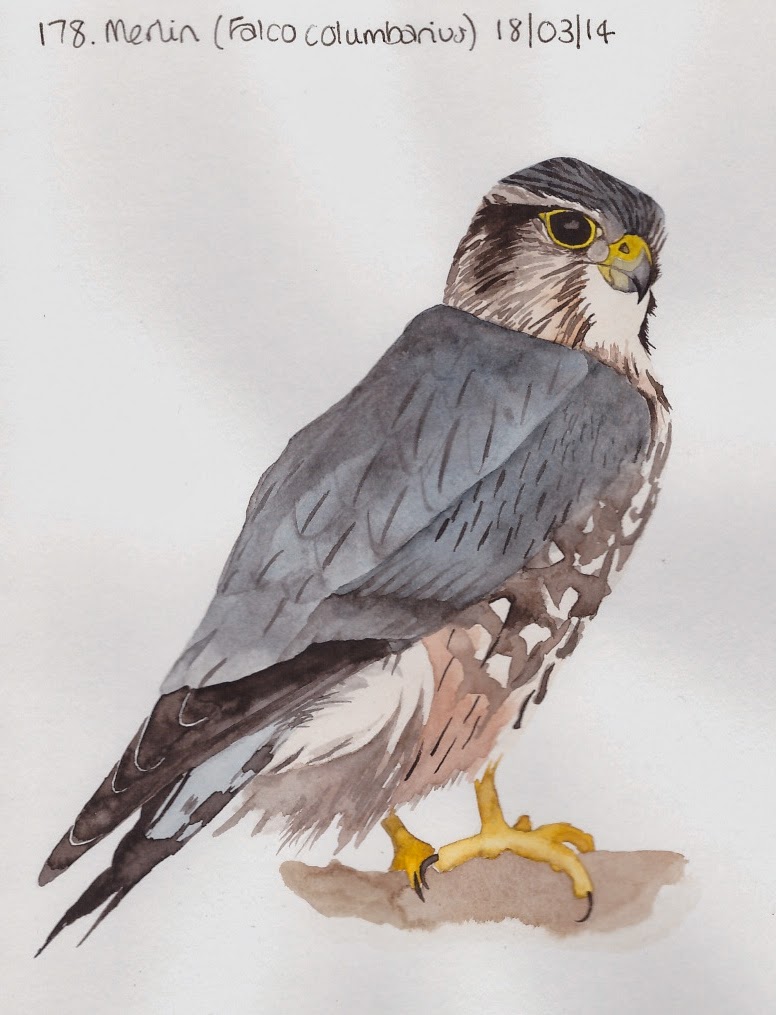
178. Merlin (Falco columbarius)

Merlins are tiny wee falcons, the smallest you will see in the UK. Like many of the falcons the female is larger than the male, enabling her to catch larger prey - they usually feed on small birds snatched in flight such as Meadow Pipits, although one time at Frampton Marsh we saw a female Merlin feeding on what looked from the feathers a lot like a Lapwing. Merlins are very widely distributed, having a circumpolar distribution in the Northern Hemisphere. In the UK they are not numerous; they are resident in some parts whereas in others (mostly in the north) they are only present in the breeding season, and in many southern parts they are only present in the winter.They breed in open, fairly remote areas - moorland, heathland, bogs and tundra. In winter they are often to be found at coastal marshes and farmland. The male is illustrated; rather like in Sparrowhawks, he has a blue-grey back and rufous-tinged underparts, and the female and juvenile are brown above with coarse dark streaking on a pale breast. The male has a black terminal band on his tail and the female's is boldly striped dark and pale brown. They have quite short, pointed wings and are very agile in flight when chasing their prey.

Merlin, ©rogerwshaw, via Flickr Creative Commons.
Merlin painting.
Pleased with this one! Well I'm not sure if taking a short break from painting has really helped with my thumb or not, which probably means it hasn't. So I thought I would recommence, I have fashioned some fat cardboard tubes to stick around my paintbrushes (and pens) which makes holding them much easier and more comfortable. I checked on the correct way to hold a pen too and it looks nothing like how I'd been holding my pens! So hopefully changing that will help.